Author

admin

Browsing

The Trump administration on Friday officially designated two of Haiti’s most powerful gang networks, Viv Ansanm and Gran Grif, foreign terrorist organizations (FTOs) and specially designated global terrorists (SDGTs).

The move is aimed at disrupting the gangs’ operations and supporting efforts to restore order in the troubled Caribbean nation.

The announcement was made in a formal statement from Secretary of State Marco Rubio, who declared that ‘the age of impunity for those supporting violence in Haiti is over.’

‘These gangs have killed and continue attacking the people of Haiti, Haitian security forces and multinational security support (MSS) mission personnel and are committed to overthrowing the government of Haiti,’ Rubio said. ‘Their ultimate goal is creating a gang-controlled state where illicit trafficking and other criminal activities operate freely and terrorize Haitian citizens.’

The designations bring serious legal consequences. Individuals or entities that provide material support to Viv Ansanm or Gran Grif could face criminal charges, loss of immigration benefits or removal from the U.S.

Viv Ansanm formed in September 2023 through an alliance between Haiti’s two main gang factions, G-9 and G-Pép. The coalition has carried out coordinated attacks on Haitian infrastructure, including prisons, government buildings and the Port-au-Prince international airport. These attacks were part of a broader campaign that helped force the resignation of former Haitian Prime Minister Ariel Henry.

Gran Grif operates mainly in the Artibonite region, a vital agricultural area. The State Department said the gang has been responsible for 80% of civilian death reports in that area since 2022. In February 2025, Gran Grif was linked to an attack that killed a Kenyan officer with the MSS mission.

According to NPR reporting from 2024, Viv Ansanm was spearheaded by Jimmy Chérizier, known as Barbecue, a former police officer turned gang leader. 

Chérizier helped unify rival gangs under a shared goal of opposing the Haitian government. In an interview with NPR, he defended the gang’s actions and blamed Haiti’s political elite for fostering the lawlessness. Though he acknowledged the violence, he claimed the government had enabled the conditions leading to it.

‘These designations play a critical role in our fight against these vicious groups and are an effective way to curtail support for their terrorist activities,’ Rubio said. He also warned that U.S. citizens and lawful residents who engage in transactions with these groups are exposing themselves to sanctions and prosecution.

Rubio praised the Haitian National Police and international partners for their efforts in pushing back against the gangs. ‘We commend the extraordinary bravery of the Haitian National Police and all international partners supporting the MSS mission for their ongoing efforts to establish stability and security in Haiti,’ he said.

He called on Haitian political leaders to focus on restoring peace. 

‘We urge all of Haiti’s political leaders to prioritize the security of the Haitian people, find solutions to stop the violence and make progress toward the restoration of democracy through free and fair elections,’ Rubio said.

The State Department did not immediately respond to Fox News Digital’s request for comment.

This post appeared first on FOX NEWS

A new report warns that NATO is unprepared for modern digital warfare. Without stronger leadership, especially from the U.S., the alliance could face serious security risks.

The Center for European Policy Analysis (CEPA) released a study showing that many NATO members are failing to modernize their military data systems.

Although NATO leaders talk about the importance of secure and shared cloud infrastructure, most countries still store critical military information in local servers that are vulnerable to cyberattacks.

The report calls data the ‘currency of warfare’ and urges NATO to improve how it stores and shares military information.

At the moment, most NATO countries are building separate national cloud systems. France uses Thales, Germany uses Arvato, and Italy is working with Leonardo to develop sovereign defense cloud services, according to the CEPA report Defend in the Cloud: Boost NATO Data Resilience.

The U.S. has its own approach, using Amazon, Google, Microsoft and Oracle to build a sovereign cloud for the Department of Defense, as noted in the same CEPA report.

This fragmented setup is creating major problems. The CEPA report explains that many of these national systems are not interoperable, which makes it difficult for NATO allies to share intelligence or respond rapidly in times of crisis.

Although 22 NATO members have pledged to build shared cloud capabilities, progress has been slow. CEPA describes a gap between what leaders promise and what is actually getting done, and the process remains slow and overly bureaucratic.

Some of the hesitation stems from political tensions. 

Since returning to office, President Donald Trump has reinforced his long-standing position that NATO members must meet their defense spending commitments. 

In early 2025, Trump proposed raising the target above the current 2% benchmark and stated publicly that the U.S. would only defend NATO allies who meet what he considers their ‘fair share’ of the burden.

At the same time, Trump has taken credit for strengthening the alliance by pushing European governments to boost their defense budgets. 

In March, he pointed to what he called ‘hundreds of billions of dollars’ in new allied defense spending as proof that his pressure was effective. His administration continues to engage in high-level NATO meetings and has publicly affirmed support for the alliance’s core mission.

Secretary of State Marco Rubio has worked to reassure European partners. During an April meeting with NATO foreign ministers in Brussels, he stated that the U.S. is ‘as active in NATO as it has ever been,’ pushing back on claims that the administration is disengaging.

According to statements published by the State Department and reported by Reuters, Rubio emphasized that Trump is not opposed to NATO itself, but to an alliance that is under-prepared or underfunded.

Rubio is also playing a central role in U.S. efforts to broker peace in Ukraine. In early 2025, he led direct talks with Russian officials in Saudi Arabia and presented Trump’s terms for a possible ceasefire, according to official State Department readouts and contemporaneous reporting by Reuters and other outlets.

Rubio has emphasized that Ukraine and European allies will remain closely involved in the process. After a pause in U.S. aid earlier this year, he announced that military support would resume once Kyiv signaled agreement with the proposed framework for peace.

Meanwhile, NATO continues to provide assistance to Ukraine through a trust fund valued at nearly $1 billion. This figure is based on NATO’s own reporting on its Comprehensive Assistance Package, as cited in CEPA’s April report.

The alliance is also coordinating training and equipment donations, but the CEPA report makes it clear that efforts are being slowed by a lack of secure data sharing.

The report points to Estonia as a model for digital resilience. Estonia backs up its government data in Luxembourg through a ‘data embassy’ system, ensuring it remains protected even if local systems are attacked. NATO, according to CEPA, should encourage similar strategies across the alliance.

According to CEPA, the U.S. is best positioned to lead the way, with Trump and Rubio already taking the necessary steps to push NATO in the right direction.

The White House did not immediately respond to Fox News Digital’s request for comment.

CEPA’s report can be reviewed here.

This post appeared first on FOX NEWS

NEWYou can now listen to Fox News articles!

President Trump announced his first judicial nominee of his second term, kicking off what will be a historic next four years as he continues to build on the most consequential accomplishment of his first term by appointing even more bold and fearless judges. The stakes could not be higher as Democrat activist judges are actively sabotaging American voters, the presidency, our Constitution, and our country.   

Trump nominated Whitney Hermandorfer to a Tennessee-based seat on the U.S. Court of Appeals for the Sixth Circuit. She is a brilliant legal mind and committed constitutionalist who has litigated critical First Amendment issues. Trump’s first nomination stands in stark contrast to the Obama- and Biden-appointed Democrat activist judges who have repeatedly attempted to sabotage the president’s core Article II executive powers during these first months of Trump’s historic second term. These anti-American judges, who side with Hamas supporters, MS-13 gang members, and no-show federal bureaucrats leeching on the taxpayer, need to be countered. Trump’s nominees promise a return to the original vision of a judiciary grounded in constitutionalism and judicial restraint.

During his 2016 campaign, Trump boldly and brilliantly ran on the issue of judicial nominations in an unprecedented way. He released a list of potential Supreme Court candidates from which he would choose to fill the vacancy arising from Justice Antonin Scalia’s death. This list of nominees set him apart from his rival at the time, Hillary Clinton. Had Clinton won, we would have been subjected to leftist judicial tyranny for at least a generation. Fortunately for the Constitution and the American people, Trump prevailed, and the country was rewarded with Justice Neil Gorsuch instead of Justice Merrick Garland. Given his horrendous and truly shameful service as attorney general, Garland would have been an unmitigated disaster had he received a lifetime appointment to the Supreme Court.

Trump did not stop after the confirmation of Gorsuch. Justice Brett Kavanaugh’s confirmation shifted the balance of the Court in 2018, as he replaced Anthony Kennedy, the pivotal justice in countless landmark cases. The coup de gras came in 2020, when Trump replaced liberal lion Ruth Bader Ginsburg with the more conservative Amy Coney Barrett. This dramatic shift paid dividends in short order and in many consequential ways.

In 2022, the Court overruled Roe v. Wade (1973) in Dobbs v. Jackson Women’s Health Organization and restored the issue of abortion to its rightful place: the states. The justices also strengthened the Second Amendment in New York State Rifle & Pistol Association v. Bruen, ruling that the Second Amendment requires ‘shall-issue’ concealed-carry permits. No longer can states have foggy standards where bureaucrats whimsically decide whether to allow citizens to carry concealed weapons. States must set forth standards, and citizens who satisfy those standards will be able to carry such firearms.

The next year, the Court put a stop to the practice of race-based college admissions policies in two cases involving Harvard and the University of North Carolina. Thanks to the rulings in Students for Fair Admissions, students must be evaluated based on merit. Conservatives had been trying for decades to eliminate affirmative action, just as they had abortion. Trump made these dreams come true. Last year, the Court struck a giant blow against the administrative state in Loper Bright Enterprises v. Raimondo, a decision that overturned the requirement that courts defer to administrative agencies when a statute is ambiguous.

He will look beyond the garden-variety Federalist Society choices and install a new generation of judicial titans who will change the landscape for generations to come in line with our Founders’ intent.

Just days after Loper Bright, the justices strengthened the presidency in Trump v. United States. There, the Court held that presidents are absolutely immune when exercising core Article II powers like pardons and at least presumptively immune for acts done within the outer perimeters of their official duties. This ruling enormously aided Trump against the lawfare perpetrated by the Biden Justice Department.

Trump’s judicial impact extended beyond the Supreme Court. He appointed 54 circuit judges in his first term, second only to President Jimmy Carter’s 56 in a single term. Carter benefited enormously from the Democrat-controlled Congress’s creation of 35 new circuit judgeships during his term. Congress created none for Trump. More importantly, Carter did not appoint any Supreme Court justices. Trump’s impact on the judiciary dwarfs Carter’s by any reasonable metric. Trump appointed only one fewer circuit judge in one term than did President Obama in two, and several of Obama’s appointees were to the Federal Circuit, a court with comparatively less impact than the other circuits on crucial issues. More importantly, Obama’s two Supreme Court appointments did not shift the balance of the Court; he replaced two leftist justices with two others. Trump also has an excellent chance to surpass President Ronald Reagan’s record for circuit confirmations of 83.

The accomplishments of Trump’s first term were excellent, but there is still work to be done. At times, the Supreme Court has been frustrating with rulings, mainly on the emergency docket with respect to Trump’s policies and the leftist inferior court judges who have enjoined them. Thanks to the Republican-controlled Senate—and a wider majority than existed in the first two years of his first term—Trump will select even more bold and fearless nominees. He will look beyond the garden-variety Federalist Society choices and install a new generation of judicial titans who will change the landscape for generations to come in line with our Founders’ intent.

Trump has assembled an excellent judicial nominations team in Attorney General Pam Bondi, White House chief of staff Susie Wiles, White House counsel Dave Warrington, and his deputy Steve Kenny to help him identify, vet, and nominate bold and fearless judges. The Article III Project, which I founded, is proud to support and assist their efforts and these excellent nominees, who will uphold the law and Constitution without fear or political consideration. We will continue to dedicate our resources and expertise to ensure only the most bold and fearless judges are nominated and confirmed to the bench.

This post appeared first on FOX NEWS

Netflix is on a winning streak.

The streaming giant’s stock has traded for 11 straight days without a decline, the company’s longest positive run ever.

Its previous record was a nine-day stretch in late 2018 and early 2019 when the stock traded up for four days, was unchanged for a day and then traded positively for another four days.

The stock is also trading at all-time high levels since it went public in May 2002.

This new streak comes on the heels of Netflix’s most recent earnings report on April 17, in which it revealed that revenue grew 13% during the first quarter of 2025 on higher-than-forecast subscription and advertising dollars.

Netflix has been one of the top performing stocks during the first 100 days of President Donald Trump’s second term, with shares up more than 30% since mid-January. The company has been largely unaffected by Trump’s tariffs and trade war with China and is a service that consumers are unlikely to cut during a recession.

Meanwhile, traditional media stocks have been slammed by a tumultuous market prompted by Trump’s trade policy. Warner Bros. Discovery has lost nearly 10% since Trump took office, while Disney is down 13% in that same period.

Netflix continues to forecast full-year revenue of between $43.5 billion and $44.5 billion.

“There’s been no material change to our overall business outlook,” the company said in a statement last month.

As investors worry about the potential impact of tariffs on consumer spending and confidence, Netflix’s co-CEO Greg Peters said on the company’s earnings call, “Based on what we are seeing by actually operating the business right now, there’s nothing really significant to note.”

“We also take some comfort that entertainment historically has been pretty resilient in tougher economic times,” Peters said. “Netflix, specifically, also, has been generally quite resilient. We haven’t seen any major impacts during those tougher times, albeit over a much shorter history.”

JPMorgan said Thursday that it sees more upside for shares.

“NFLX has established itself as the clear leader in global streaming & is on the pathway to becoming global TV…Advertising Upfronts in May should serve as a positive catalyst to shares,” analysts wrote.

While Netflix has hiked its subscription prices — its standard plan now costs $17.99, its ad-supported plan is $7.99 and premium is $24.99 — it appears to have retained its value proposition for customers. But it’s unclear if the subscriber base is growing or shrinking because the company recently stopped sharing details on its membership numbers, instead focusing on revenue growth.

This post appeared first on NBC NEWS

Amazon founder Jeff Bezos plans to sell up to 25 million shares in the company over the next year, according to a financial filing on Friday.

Bezos, who stepped down as CEO in 2021 but remains Amazon’s top shareholder, is selling the shares as part of a trading plan adopted on March 4, the filing states. The stake would be worth about $4.8 billion at the current price.

The disclosure follows Amazon’s first-quarter earnings report late Thursday. While profit and revenue topped estimates, the company’s forecast for operating income in the current quarter came in below Wall Street’s expectations.

The results show that Amazon is bracing for uncertainty related to President Donald Trump’s sweeping new tariffs. The company landed in the crosshairs of the White House this week over a report that Amazon planned to show shoppers the cost of the tariffs. Trump personally called Bezos to complain, and Amazon clarified that no such change was coming.

Bezos previously offloaded about $13.5 billion worth of Amazon shares last year, marking his first sale of company stock since 2021.

Since handing over the Amazon CEO role to Andy Jassy, Bezos has spent more of his time on his space exploration company, Blue Origin, and his $10 billion climate and biodiversity fund. He’s used Amazon share sales to help fund Blue Origin, as well as the Day One Fund, which he launched in September 2018 to provide education in low-income communities and combat homelessness.

This post appeared first on NBC NEWS

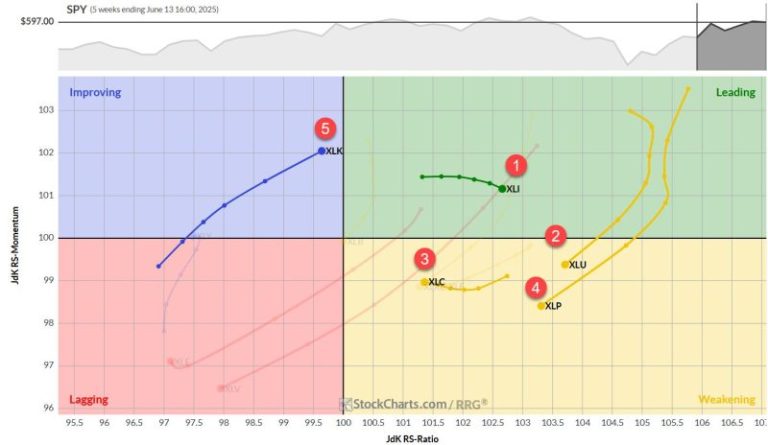
When you’re lost in the woods, you reach for a compass to find true north. In the markets, it’s not so simple, as the landscape is always shifting. If there is a “true north” in this terrain, it might be better understood as a characteristic—strength and momentum over time, rather than a single stock or sector.

With sentiment muddled and signals mixed, how do you cut through near-term noise and find the “true north” in a shifting market landscape? This is where StockCharts’ MarketCarpets comes in. You can think of it as a visual compass that can help you reorient and recalibrate.

What MarketCarpets is Saying Now

All MarketCarpets readings use the five-day setting, since shorter time frames are particularly susceptible to noise in the current context.

FIGURE 1. MARKETCARPETS S&P VIEW. Lots of green, but I want to see a reduction.

On Thursday morning, there were more bullish greens than bearish reds. They represent S&P 500 stocks performing better relative to others—specifically from a ‘long only’ (bullish) perspective. But what do those greens have in common?

The answer is that most, if not all, are Information Technology sector funds.

Technology Sector Leads the Charge in S&P 500

If you select the S&P Sector ETFs group, Technology is the strongest among all 11 S&P sectors.

FIGURE 2. MARKETCARPETS SECTORS. Technology is far ahead of most other sectors, which read bullish.

If you follow financial news, you’re probably well aware of how certain tech companies are performing, especially in light of the current earnings season.

But not every investor wants to risk allocating capital toward individual stocks, given the volatility of today’s geopolitical environment, where news on a given day can cause markets to soar or slump. So, conservative investors, particularly those in or nearing retirement, might want to opt for a sector ETF instead, like the Technology Select Sector SPDR Fund (XLK).

Why is technology outperforming?

Six Reasons Tech Stocks are Outperforming in 2025

Here’s a quick breakdown of what’s going on:

  • AI and cloud boom. Enterprise-focused giants are thriving due to surging AI demand.
  • Earnings confidence. Big tech’s strong earnings are keeping investor sentiment positive despite market volatility.
  • Tariff mitigation. Tech companies are proactively shifting supply chains to soften tariff impact.
  • Tariff relief. Temporary exemptions on key tech products give hardware makers a short-term boost.
  • Long-term innovation appeal. Investors see AI, chips, and automation as long-term growth drivers.
  • Stable revenue streams. Tech firms with enterprise and software services offer more stability than consumer-driven sectors.

Technology Sector Overbought? Market Breadth Says Maybe

That’s a lot of fundamental talk, but what does the technical picture look like? Let’s start by analyzing market breadth with the S&P Technology Sector Bullish Percent Index ($BPINFO) chart.

FIGURE 3. TECH SECTOR BPI. Most tech stocks in the sector are ultra-bullish, but that can also signal overbought conditions.

The Bullish Percent Index (BPI) is at 85, meaning 85% of all stocks within the sector are triggering Point & Figure Buy Signals. Above 50% is bullish, but above 70%, let alone 85%, XLK is straddling ultra-bullish to overbought.

If you look at the magenta rectangle, you can see where XLK’s trend is situated—at the point of recovery following a two-month tumble. However, it’s still below its 200-day simple moving average (SMA), and, as the saying goes, nothing good happens below the 200.

XLK’s Price and Volume Action: A Closer Look

Let’s zoom in on a daily chart.

FIGURE 4. DAILY CHART OF XLK. It broke above resistance, but can it sustain upward momentum?

XLK’s recovery effort gained momentum with a notable gap up on Thursday. Positive momentum is reinforced by a rising Relative Strength Index (RSI) above the 50 level, suggesting XLK still has room to run.

From a volume perspective, the On Balance Volume (OBV) indicator is trending higher, signaling increased buying pressure. A 20-day SMA is overlaid to show how OBV is performing relative to its average. However, the Chaikin Money Flow (CMF), hovering flat near the zero line (see blue circle), indicates accumulation with hesitation.

Key Support Levels to Watch If You’re Bullish on XLK

If you’re considering a long position in XLK, keep an eye on these key technical levels:

  • Initial Support – $205. The breakout level around $205 (marked by the blue dotted line) should act as the first line of support on any pullback.
  • Secondary Support Zone – $185 to $187.50. If $205 fails, the yellow-shaded zone becomes the next support range. But note: if price falls here, the $205 breakout level may flip into resistance.
  • Critical Support – $172.50. A drop toward $172.50 could signal deeper technical weakness. That’s why the area is shaded red—to underscore its importance.

In each case, monitor the CMF for confirmation. A rising CMF, especially in the first two support zones, would suggest continued buying pressure—a bullish signal. Conversely, if CMF dips below the zero line, it would signal growing selling pressure, reinforcing a more bearish outlook.

At the Close

The tech sector is leading the charge, but you have to estimate whether momentum is real or just generating noise. MarketCarpets works like a compass, helping you visually navigate market conditions and spot patterns. Pair it with tools like RSI, OBV, CMF, or any other preferred tool in your analytical toolbox to create well-defined setups and exits. In a market environment driven by sentiment, headlines, fear, and FOMO, having a solid technical foundation is more important than ever.


Disclaimer: This blog is for educational purposes only and should not be construed as financial advice. The ideas and strategies should never be used without first assessing your personal and financial situation, or without consulting a financial professional.

International Lithium Corp. (TSXV: ILC) (OTCQB: ILHMF) (FSE: IAH) (the ‘Company’ or ‘ILC’) is pleased to announce that it is increasing the size of its non-brokered private placement financing (the ‘Offering’) from $600,000 to $855,000 and extending the closing of the Offering to May 30, 2025. The Offering was originally announced on February 5, 2025. The upsized Offering is comprised of up to 57,000,000 common shares of the Company at a price of $0.015 per share for gross proceeds of up to $855,000.

On March 31, 2025, the Company closed the first tranche the Offering and issued 23,666,666 common shares at $0.015 per share for proceeds of $355,000. The proposed payments from the first tranche proceeds included $183,600 to pay the outstanding fees to non-arm’s length creditors.

Proceeds of the private placement will be used primarily for general working capital purposes. The payments to persons conducting Investor Relations Activities shall not exceed 10% of the proceeds.

Closing of the Offering is subject to acceptance by the TSX Venture Exchange. All securities issued in connection with the Offering will be subject to a four-month hold period from the closing date under applicable Canadian securities laws.

It is anticipated that some directors and insiders will participate in the future tranches of the Offering. The issue of shares (to the extent subscribed for by insiders) constitute ‘related party transactions’ pursuant to Multilateral Instrument 61-101 – Protection of Minority Security Holders in Special Transactions (‘MI 61-101’), as the subscribers include directors of the Company. The Company is exempt from the requirements to obtain a formal valuation or minority shareholder approval in connection with the shares in reliance on the exemptions contained in sections 5.5(a) and 5.7(1)(a) of MI 61-101, respectively, as the fair market value of the shares does not exceed 25% of the Company’s market capitalization.

About International Lithium Corp.

While the world’s politicians are currently divided on the future of the energy market’s historic dependence on oil and gas and on ‘Net Zero’, there seems a clear and unstoppable momentum towards electric vehicles and electric battery storage. We have also seen the clear and increasingly urgent wish by the USA and Canada and other major economies to safeguard their supplies of critical metals and to become more self-sufficient. Our Canadian projects, which contain lithium, rubidium and copper, are strategic in that respect.

Our key mission in the next decade is to make money for our shareholders from lithium and other battery metals and rare metals while at the same time playing our part in creating a greener, cleaner planet and less polluted cities. This includes optimizing the value of our existing projects in Canada as well as finding, exploring and developing projects that have the potential to become world class deposits. We have announced separately that we regard Zimbabwe as an important strategic target market for ILC, and that we have applied for and hope to receive EPOs there. We hope to be able to make announcements over the next few weeks and months.

The Company’s interests in various projects now consists of the following, and in addition the Company continues to seek other opportunities:

Name Metal Location Area (Hectares) Current Ownership Percentage Future Ownership percentage if options exercised or work carried out Operator or JV Partner
Raleigh Lake Lithium
Rubidium
Ontario 32,900 100% 100% ILC
Firesteel Copper
Cobalt
Ontario 6,600 90% 90% ILC
Wolf Ridge Lithium Ontario 5,700 0% 100% ILC
Mavis Lake Lithium Ontario 2,600 0% 0%
(carries an extra earn-in payment of CAD$ 0.7 million if resource targets met)
Critical Resources Ltd
( ASX: CRR)
Avalonia* Lithium Ireland 29,200 0% 2.0% Net Smelter Royalty Ganfeng Lithium
Forgan/
Lucky Lakes
Lithium Ontario 0% 1.5% Net Smelter Royalty Ultra Lithium Inc.
( TSXV: ULT)
*Sale not completed yet


The Company’s primary strategic focus at this point is on the Raleigh Lake lithium and rubidium project and the Firesteel copper project in Canada and on obtaining EPOs and mineral claims in Zimbabwe.

The Raleigh Lake Project now consists of 32,900 hectares (329 square kilometres) of mineral claims in Ontario and is ILC’s most significant project in Canada. Drilling has so far been on less than 1,000 hectares of our claims. A Preliminary Economic Assessment( PEA) was published for ILC’s lithium at Raleigh Lake in December 2023, with detailed economic analysis of ILC’s separate rubidium resource still to come. Raleigh Lake is 100% owned by ILC, is not subject to any encumbrances, and is royalty free. The project has excellent access to roads, rail and utilities.

A continuing goal has been to remain a well-funded company to turn our aspirations into reality, and following the disposal of the Mariana project in Argentina in 2021, the Mavis Lake project in Canada in January 2022, and the Avalonia project in 2024 (sale not completed yet), ILC has achieved sufficient inward cashflow to be able to make progress with its exploration projects.

With the increasing demand for high tech rechargeable batteries used in electric vehicles and electrical storage as well as portable electronics, lithium has been designated ‘the new oil’ and is a key part of a green energy sustainable economy. By positioning itself with projects with significant resource potential and with solid strategic partners, ILC aims to be one of the lithium and rare metals resource developers of choice for investors and to continue to build value for its shareholders in the ’20s, the decade of battery metals.

On behalf of the Company,

John Wisbey
Chairman and CEO

www.internationallithium.ca

For further information concerning this news release please contact +1 604-449-6520

Neither TSX Venture Exchange nor its Regulation Services Provider (as that term is defined in the policies of the TSX Venture Exchange) accepts responsibility for the adequacy or accuracy of this release.

Cautionary Statement Regarding Forward-Looking Information

Except for statements of historical fact, this news release or other releases contain certain ‘forward-looking information’ within the meaning of applicable securities law. Forward-looking information or forward-looking statements in this or other news releases may include: the timing of completion of the Offering and the amounts to be raised, effect of results of anticipated production rates, the timing and/or anticipated results of drilling on the Raleigh Lake or Firesteel or Wolf Ridge projects, the expectation of resource estimates, preliminary economic assessments, feasibility studies, lithium or rubidium or copper recoveries, modeling of capital and operating costs, results of studies utilizing various technologies at the company’s projects, budgeted expenditures and planned exploration work on the Company’s projects, increased value of shareholder investments, the potential from the company’s third party earn-out or royalty arrangements, and assumptions about ethical behaviour by our joint venture partners or third party operators of projects. Such forward-looking information is based on assumptions and subject to a variety of risks and uncertainties, including but not limited to those discussed in the sections entitled ‘Risks’ and ‘Forward-Looking Statements’ in the interim and annual Management’s Discussion and Analysis which are available at www.sedar.com. While management believes that the assumptions made are reasonable, there can be no assurance that forward-looking statements will prove to be accurate. Should one or more of the risks, uncertainties or other factors materialize, or should underlying assumptions prove incorrect, actual results may vary materially from those described in forward-looking information. Forward-looking information herein, and all subsequent written and oral forward-looking information are based on expectations, estimates and opinions of management on the dates they are made that, while considered reasonable by the Company as of the time of such statements, are subject to significant business, economic, legislative, and competitive uncertainties and contingencies. These estimates and assumptions may prove to be incorrect and are expressly qualified in their entirety by this cautionary statement. Except as required by law, the Company assumes no obligation to update forward-looking information should circumstances or management’s estimates or opinions change.

NOT FOR DISTRIBUTION TO UNITED STATES NEWS WIRE SERVICES OR FOR DISSEMINATION IN THE UNITED STATES

To view the source version of this press release, please visit https://www.newsfilecorp.com/release/250515

News Provided by Newsfile via QuoteMedia

This post appeared first on investingnews.com

Uranium.io is a next-generation platform transforming access to physical uranium (U₃O₈) through the power of blockchain technology. It empowers both individual and institutional investors to directly own and trade uranium, eliminating many of the traditional barriers, such as high costs, limited transparency, and market inefficiencies. Each xU₃O₈ token is fully backed by physical uranium stored in a secure, regulated facility operated by Cameco. Custodianship is provided by Archax, a UK-regulated digital asset firm, ensuring robust transparency and trust in the asset’s backing.

The platform meets rising investor demand for uranium—a key driver of the global energy transition. As nations pursue net-zero targets, nuclear energy is gaining momentum as a reliable, low-carbon power source. Governments across North America, Europe, and Asia are expanding nuclear capacity by restarting reactors, building new ones, and advancing small modular reactor development.

Uranium.io combines blockchain, digital custody, and real-world uranium supply to deliver secure, transparent access to the uranium market. By bridging traditional commodity trading with Web3, the platform enables users to seamlessly acquire, hold, and trade physical uranium through xU₃O₈ tokens.

Company Highlights

  • Uranium.io is a pioneering platform for buying and selling uranium, providing direct ownership of physical uranium via a blockchain-powered token xU3O8.
  • Built on Etherlink, powered by Tezos technology, enabling transparency, low fees, energy efficiency and programmable compliance.
  • FCA-regulated digital asset custodian, Archax, holds physical uranium in trust on behalf of token holders.
  • Physical supply is brokered by Curzon Uranium, a trusted uranium trading and logistics partner with deep industry roots and over $1 billion in uranium trades.
  • The uranium bought on the platform is physically stored at a regulated depository owned and operated by Cameco, one of the world’s leading global uranium providers/converters.
  • Global 24/7 market access offering fractionalized and direct uranium exposure with real-time settlement and cross-border accessibility.
  • Capitalizing on nuclear energy’s role in clean energy transition and the financialization of critical minerals.

This Uranium.io profile is part of a paid investor education campaign.*

Click here to connect with xU3O8 (uranium.io) to receive an Investor Presentation

This post appeared first on investingnews.com

Discover the top 10 stock charts to watch this month with Grayson Roze and David Keller, CMT. They break down breakout strategies, moving average setups, and technical analysis strategies using relative strength, momentum, and trend-following indicators. This analysis covers key market trends that could impact your trading decisions. You don’t want to miss these insights into market dynamics and chart patterns that could impact your trading decisions.

This video originally premiered on May 1, 2025. Click on the above image to watch on our dedicated Grayson Roze page on StockCharts TV.

You can view previously recorded videos from Grayson at this link.

Manganese, a key ingredient for the steel market, is also seeing growth in demand from the electric vehicle battery sector, particularly when it comes to high-purity manganese chemical products.

Manganese investors are often interested to hear which countries produce the most of the metal. After all, if a nation is producing a lot of manganese, many companies are likely operating there, and investment opportunities may thus be available.

However, what investors sometimes fail to consider is manganese reserves, or how much economically mineable manganese a country holds, and which companies are working to bring those reserves into production.

Here’s an overview of the five countries with the highest manganese reserves. Data for this list of manganese reserves by country comes from the US Geological Survey’s 2025 report on manganese.

1. South Africa

Manganese reserves: 560 million metric tons

At 560 million metric tons, South Africa holds the highest manganese reserves in the world by a long shot. The nation is also the world’s top producer of the metal, with 2024 output of 7.4 million metric tons.

South32 (ASX:S32,LSE:S32,OTC Pink:SHTLF) is a major presence in the South African manganese space. Its South Africa Manganese operation is located in the manganese-rich Kalahari Basin and consists of the open-pit Mamatwan mine, the underground Wessels mine and the Metalloys manganese alloy smelter.

Another ASX-listed manganese miner, Jupiter Mines (ASX:JMS,OTC Pink:JMXXF) is also operating in the area at its Tshipi Borwa mine, considered the largest manganese mine in country and one of the largest in the world.

2. China

Manganese reserves: 280 million metric tons

The country with the next highest manganese reserves is China at 280 million metric tons of manganese. The Asian nation is also the sixth largest producer of manganese ore, the largest producer of refined manganese and the largest consumer of the metal. Unsurprisingly, China’s economy and government regulations have an outsized impact on the global manganese market.

There have been several significant manganese discoveries in China over the last decade. In late 2023, new manganese deposits were discovered in the southeast province of Jiangxi during government-led exploration work, and manganese deposits were discovered in the southwest province of Guizhou in 2017. More recently, in March 2025, Chinese government geologists confirmed an inferred resource estimate of 6.07 million tons of manganese ore in the Maowanli manganese project in the Sichuan province.

Looking further down the value added chain, Australian miner Firebird Metals (ASX:FRB,OTC Pink:FRBMF) has partnered with a subsidiary of China National Chemical Engineering Co. (SHA:601117) to build a high-purity manganese sulphate plant in China, which has entered pilot production. Firebird has an ore supply agreement in place with Eramet (EPA:ERA) for manganese ore to feed the plant, and it could potentially be supplied by Firebird’s Oakover manganese project in Australia in the future.

3. Brazil

Manganese reserves: 270 million metric tons

Brazil hosts a total of 270 million metric tons of manganese reserves as of 2024. The country produced 590,000 metric tons of the metal in 2024, making it the seventh-largest manganese-producing country.

Buritirama Mining, a subsidiary of Grupo Buritipar, is Brazil’s leading producer of the metal. The company invested US$200 million in 2023 to expand operations at its Para state mine.

Major miner Vale (NYSE:VALE), previously the largest manganese miner in the country, offloaded its Brazilian manganese and iron ore assets to J&F Investimentos in 2022. Going forward, J&F has said it plans to invest more than US$1 billion in increasing the iron ore and manganese output from the mines it purchased from Vale.

4. Australia

Manganese reserves: 110 million metric tons

At 110 million metric tons, Australia holds the fourth highest manganese reserves in the world. The nation is also the world’s third largest producer of the metal. In 2024, Australia’s manganese output came in at 2.8 million metric tons.

Australia’s largest manganese ore producer is Groote Eylandt, a 60/40 joint venture between South32 and Anglo American (LSE:AAL,OTCQX:AAUKF), in the nation’s Northern Territory. In mid-March 2024, operations at Groote Eylandt were negatively impacted by Tropical Cyclone Meghan — the second strongest cyclone to hit the area in the past two decades.

The storm damaged critical infrastructure at the site, including a haulage bridge between the mine and processing facilities, as well as the wharf from which manganese ore is shipped. South32 is currently conducting engineering studies to determine a schedule and capital costs to make the repairs needed to restore operations at Groote Eylandt.

As of mid-April 2025, South32 had completed construction at the wharf and expected to start export sales again in May.

5. Gabon

Manganese reserves: 61 million metric tons

Gabon hosts the fifth largest manganese reserves in the world at 61 million metric tons; however, the Central African nation is the second largest producer of the metal with an output of 4.6 million metric tons in 2024.

Gabon is also the largest source of US manganese imports at 63 percent in 2024 compared to 23 percent from South Africa.

Eramet’s Moanda mine is a centerstone of the country’s manganese mining sector and it is based on one of the world’s richest manganese deposits. Eramet is the world’s second largest miner of high-grade manganese ore and operates the mine through its subsidiary COMILOG. In response to an oversupplied market, Eramet temporarily paused production at Moanda in the fourth quarter of 2024, but it has since recommenced.

Securities Disclosure: I, Melissa Pistilli, hold no direct investment interest in any company mentioned in this article.

Keep reading…Show less
This post appeared first on investingnews.com