Cardiex Limited (CDX:AU) has announced Appendix 4E
Download the PDF here.
This post appeared first on investingnews.com


Cardiex Limited (CDX:AU) has announced Appendix 4E
Download the PDF here.

Cardiex Limited (CDX:AU) has announced FY25 Preliminary Results Summary and Company Update
Download the PDF here.

Carbonxt Group (CG1:AU) has announced FY25 Results Announcement
Download the PDF here.

Metro Mining (MMI:AU) has announced 2025 Half Year Results
Download the PDF here.

A spokesperson for Kamala Harris confirmed to Fox News on Friday that the former vice president’s Secret Service protection has been revoked by President Donald Trump.
The spokesperson added that there was no reason given as to why it was removed.
A senior White House official told Fox News Digital that vice presidents usually have a Secret Service detail for only six months after departing office.
A source briefed on the matter also told Fox News that the decision to revoke Harris’ Secret Service protection was made yesterday and that is when the Secret Service was notified.
Former President Joe Biden signed an executive memorandum before leaving office which extended Harris’ protection for an additional year after the normal six months that former vice presidents received in the past.
On Thursday, Trump rescinded that memorandum and Harris’ Secret Service protection officially ends on Sept. 1.
The move comes as Harris is set to kick off a tour for her upcoming book ‘107 Days’ in late September.
The tour is scheduled to visit major American cities in its opening days, including New York City, Philadelphia and Los Angeles.
This is a developing story. Please check back for updates.

Bipartisan anger is brewing over the drama that unfolded at the Centers for Disease Control (CDC), with the top members of the Senate’s healthcare panel forming a united front in the midst of the turmoil.
Senate Healthcare, Education, Labor and Pensions Committee Chair Bill Cassidy, R-La., and the panel’s ranking member, Sen. Bernie Sanders, I-Vt., dove head first into the issues stemming from the firing of CDC Director Susan Monarez, which spurred a string of departures from the agency.
Monarez was abruptly fired from her position by the Department of Health and Human Services (HHS), less than a month after being confirmed by the Senate. Her removal, which her lawyers rejected, appeared to stem from disagreements over vaccines with HHS Secretary Robert F. Kennedy, Jr., a vaccine skeptic.
Cassidy was the deciding vote during Kennedy’s confirmation hearing earlier this year.
Monarez has since refused to leave the post, with her lawyers arguing that she had neither resigned nor been fired and had not received notification from the president of her removal.
Following news of her ouster, a string of top officials at the CDC announced their resignations, too, including National Center for Emerging and Zoonotic Infectious Diseases Director Dr. Daniel Jernigan, Chief Medical Officer Debra Houry, National Center for Immunization and Respiratory Diseases Director Demetre Daskalakis and Director of Public Health Data, Science, Technology Jennifer Layden.
In response to their resignations, Cassidy demanded that the federal government’s vaccine advisory panel, which was filled with Kennedy’s handpicked replacements after he recently booted the original panel members, postpone its scheduled meeting in September.
His demand marks the second time this year that Cassidy called on the panel to halt its meeting, a move that directly bucks Kennedy’s and President Donald Trump’s Make America Healthy Again (MAHA) agenda.
Cassidy argued Thursday that there were ‘serious allegations made about the meeting agenda, membership, and lack of scientific process being followed for the now announced September [Advisory Committee on Immunization Practices] meeting.’
‘These decisions directly impact children’s health, and the meeting should not occur until significant oversight has been conducted,’ Cassidy said. ‘If the meeting proceeds, any recommendations made should be rejected as lacking legitimacy given the seriousness of the allegations and the current turmoil in CDC leadership.’
Daskalakis posted his reason for resigning on X, where he charged that he was ‘unable to serve in an environment that treats CDC as a tool to generate policies and materials that do not reflect scientific reality and are designed to hurt rather than to improve the public’s health.’
Meanwhile, Sanders demanded a congressional investigation be opened into the Trump administration’s decision to fire Monarez.
‘We need leaders at the CDC and HHS who are committed to improving public health and have the courage to stand up for science, not officials who have a history of spreading bogus conspiracy theories and disinformation,’ Sanders said Thursday.
HHS did not immediately respond to a request for comment for this story.
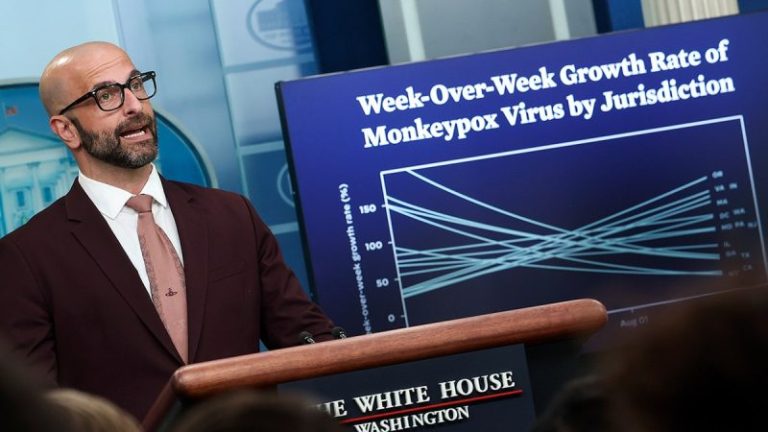
A Centers for Disease Control and Prevention official who posted his resignation letter on social media used the term ‘pregnant people’ and capped off his missive by including ‘he/his/him’ pronouns after his name.
‘I am writing to formally resign from my position as Director of the National Center for Immunization and Respiratory Diseases at the Centers for Disease Control and Prevention (CDC), effective August 28, 2025, close of business,’ Dr. Demetre Daskalakis wrote in the lengthy post on X.
Daskalakis accused President Donald Trump’s administration of attempting ‘to erase transgender populations.’
‘For decades, I have been a trusted voice for the LGBTQ community when it comes to critical health topics. I must also cite the recklessness of the administration in their efforts to erase transgender populations, cease critical domestic and international HIV programming, and terminate key research to support equity as part of my decision,’ he wrote.
The inclusion of pronouns and the term ‘pregnant people’ caught people’s attention.
‘This resignation is a huge win for the Trump administration and the American people. We don’t need anyone who can’t understand basic biology working at the CDC,’ noted Jeremy Redfern, communications director for Florida Attorney General James Uthmeier.
Karol Markowicz tweeted, ‘No one who uses ‘pregnant people’ should work at the CDC. This isn’t hard.’
Responding to Markowicz’s post, Florida Gov. Ron DeSantis wrote, ‘Example of how ‘trusting the science’ really means following the political science and perpetuating the prevailing narrative…’ He added, ‘Embracing evidence-based medicine should be the bare minimum for working at the CDC…’
Daskalakis suggested that the Department of Health and Human Services is on a ‘dangerous’ path.
‘I am unable to serve in an environment that treats CDC as a tool to generate policies and materials that do not reflect scientific reality and are designed to hurt rather than to improve the public’s health,’ he wrote.
‘I wish the CDC continued success in its vital mission and that HHS reverse its dangerous course to dismantle public health as a practice and as an institution. If they continue the current path, they risk our personal well-being and the security of the United States,’ Daskalakis concluded at the end of his message.
Fox News Digital reached out to HHS for comment on Thursday.

An American energy leader is warning that several progressive ‘green’ environmental groups opposing President Donald Trump’s nuclear energy plans are linked to a ‘web of dark money’ groups with ties to former President Barack Obama and other Democrats.
Jason Isaac, CEO of the American Energy Institute, warned during an interview with Fox News Digital that while claiming to stand for the planet, these groups ‘have prioritized ideology over innovation’ and are ‘driven by green activists and groups deeply tied to the Democratic Party.’
‘You follow the money, you’ll see where it leads. It leads straight to partisan mega-donors, foreign interests, and failed climate crusaders,’ Isaac said. ‘This isn’t about the environment. It’s about political control over America’s energy future and our energy dominance.’
Isaac’s comments follow Trump’s signing of several executive orders in May to ‘usher in a nuclear renaissance’ by cutting red tape to accelerate advancements in nuclear technologies. In one of the orders, Trump said that ‘abundant energy is a vital national- and economic-security interest’ and ‘in conjunction with domestic fossil fuel production, nuclear energy can liberate America from dependence on geopolitical rivals.’
However, several environmentalist groups, such as the Union of Concerned Scientists, Nuclear Threat Initiative, Greenpeace, Friends of the Earth, the Sierra Club and several individuals have been critical of Trump’s actions as unscientific.
In late July, the Union of Concerned Scientists published a statement lambasting Trump, saying that ‘since the Inauguration, the administration has systematically destroyed federal scientific systems.’
UCS published a report that claimed the Trump administration is advancing a ‘systematic effort to suppress climate science and dismantle actions to address the climate crisis that will increase costs and suffering, particularly for disadvantaged communities, while boosting fossil fuel pollution and profits.’
A Fox News Digital review of UCS donors found that the group has received financial support from left-wing donors like the Tides Foundation, whose 2023 U.S. tax return shows it has helped bankroll anti-Israel protests on college campuses, and the Alliance for Global Justice, which in turn is a fiscal sponsor of the Samidoun Palestinian Prisoner Solidarity Network, a group the U.S. Department of the Treasury later designated as ‘a sham charity that serves as an international fundraiser for the Popular Front for the Liberation of Palestine (PFLP) terrorist organization.’
UCS has also received support from the U.S. Energy Foundation, which Fox News Digital previously reported was spun off from the same foundation as the Energy Foundation China.
Meanwhile, Nuclear Threat Initiative, another group that has been publicly wary of Trump’s nuclear agenda, was co-founded by Ted Turner, who once urged other countries to adopt China’s one-child policy, and led by CEO Ernest Moniz, who was secretary of energy under Obama.
Other Nuclear Threat Initiative leaders have links to Democratic causes through political contributions, such as the group’s president, Joan Rohlfing, who donated to former President Joe Biden and former Vice President Kamala Harris, its vice president, Scott Roecker, who has donated to the Democratic National Committee, and its senior director, Nickolas Roth, who donated to Biden.
A spokesperson for NTI told Fox News Digital that the organization ‘actively supports the rapid expansion of safe, secure, and cost-effective nuclear energy through the Nuclear Scaling Initiative (NSI), in partnership with the Clean Air Task Force and the EFI Foundation.’
‘NSI’s goal is to enable the scaling of more than 50 gigawatts of nuclear capacity annually across the globe by the 2030s—advancing climate goals, energy security, nonproliferation, and economic development.’
The spokesperson added that NTI is a ‘nonprofit, nonpartisan global security organization’ while pointing to a New York Post letter to the editor from Roecker pushing back on allegations of bias.
Another group, Friends of the Earth, which has actively urged the world to ‘reject’ Trump, has a history of far-left endorsements and contributions. In 2020, Friends of the Earth endorsed Black Lives Matter and called for defunding the police. The group has also endorsed the Green New Deal and said the U.S. must ‘provide finance for people in developing countries commensurate with what science and justice demand.’
During the 2020 election, Friends of the Earth Action endorsed Sen. Bernie Sanders, I-Vt., and Sen. Elizabeth Warren, D-Mass., for the Democratic presidential nomination. In 2024, the group endorsed Harris for president.
Since 2015, Friends of the Earth Action PAC has donated thousands to Democratic or progressive candidates and causes, according to data gathered by OpenSecrets.
For its part, the Sierra Club, which routinely pushes back against Trump on its social media account, has had an even more extensive history of advancing progressive causes.
In 2020, the Sierra Club supported defunding the police, saying, ‘The problems with policing can’t be solved through piecemeal reforms or getting rid of ‘a few bad apples.’’
The group also endorsed the Green New Deal, calling it a ‘big, bold transformation of the economy to tackle the twin crises of inequality and climate change.’
It has also said it is ‘committed to being an anti-racist organization.’ In 2020, the group even condemned its founder, naturalist John Muir, for using racist language in the 1800s, saying it was ‘time to take down some of our own monuments.’
The Sierra Club Foundation has, in turn, received significant support from George Soros’ Open Society Foundations, left-wing Swiss megadonor Hansjorg Wyss’s Wyss Foundation, and The Climate Imperative Foundation, which infamously pushed the Biden administration’s move to ban gas stoves.
Greenpeace, which is well known for its dramatic climate protests, including boarding an oil vessel, has been a vocal critic of Trump for years, accusing the president of ‘defying science.’
Greenpeace has received support from New Venture Fund, whose website states that its day-to-day operations are managed in part by Arabella Advisors, the behemoth philanthropy services firm that also manages left-wing ‘dark money’ funds. According to a 2017 tax filing, Greenpeace has also received funding from the Silicon Valley Community Foundation, which in turn receives funding from Mark Zuckerberg, Reed Hastings, and Jack Dorsey.
In 2020, Greenpeace touted that a staff member was involved in creating a ‘Vision for Black Lives’ platform and fully endorsed the program that called for reparations and a ‘guaranteed minimum livable income for all Black people.’ The program also supported cutting funding from law enforcement and decriminalizing ‘all drug-related offenses and prostitution.’
The group has provided funding to progressive state committees like the Colorado League of Responsible Voters, Colorado Rising for Health & Safety, and Democratic candidates and causes.
Speaking with Fox News Digital, Isaac described the groups opposing Trump’s nuclear push as a ‘whole web of dark money-funded partisan and foreign-tied organizations.’
I don’t think they want to solve the problem,’ he said, adding, ‘these groups are about control, they’re about driving the cost of energy up and driving access to energy down so they can control the narrative and control every aspect of our lives.’
Will Hild, executive director of Consumers’ Research, told Fox News Digital, ‘the reality is the green agenda is a hodgepodge of anti-human activists who have adopted the green agenda as their religion, coupled with megalomaniacs and political operatives exploiting climate issues to push a broader ideological agenda.’
‘What we have seen for years is so-called ‘green’ groups pushing an anti-nuclear agenda that defies science, common sense, and the interests of the American people,’ he said.
NTI has been publicly wary of Trump’s nuclear expansion, while UCS, Friends of the Earth, the Sierra Club and Greenpeace have been heavily critical of the administration’s actions on environmental issues more generally.
‘Nuclear energy is statistically the safest, cleanest, and most reliable source of power we have, yet the left is doing everything they can to shut it down,’ Hild went on. He criticized these ‘activist groups’ for ‘the damage they’re doing to our economy, our security, and our future in pursuit of an extreme climate ideology.’
Steve Milloy, who is a senior policy fellow at the Energy and Environment Institute and served on Trump’s 2016 transition team for the Environmental Protection Agency, also chimed in, calling the current moment ‘a critical turning point for the future of energy.’
‘For decades, radical environmental groups have tried to block nuclear energy, despite its unmatched record for safety and reliability,’ he said. ‘By championing nuclear power, the President is putting science, technology, and common sense ahead of the outdated, anti-energy green agenda pushed by the Left.’
Fox News Digital also reached out to the Sierra Club, Greenpeace, Friends of the Earth, and UCS for comment but did not receive a response.

The Trump administration’s latest allegations of mortgage fraud have raised questions about a long-standing housing issue known as owner-occupancy mortgage fraud. But that type of fraud can be difficult to prove, experts say.
President Donald Trump announced in a Truth Social post on Monday night that he was removing Federal Reserve Governor Lisa Cook. He cited allegations made by Federal Housing Finance Agency Director Bill Pulte that Cook committed mortgage fraud by claiming homes in two different states as her primary residence at the same time.
Cook’s attorney on Tuesday said Cook will file a lawsuit to challenge her removal.
“President Trump has no authority to remove Federal Reserve Governor Lisa Cook,” the lawyer, Abbe Lowell, said in a statement.
The Department of Justice has also recently targeted Sen. Adam Schiff, D-Calif., and New York Attorney General Letitia James with similar mortgage fraud allegations.
Here are the key things to know about owner-occupancy mortgage fraud, according to experts.
The main reason a borrower could be motivated to claim a primary residence on a mortgage application is to get a lower interest rate for that home.
Typically, mortgages for a primary residence have lower interest rates and homeowner’s insurance costs, said Keith Gumbinger, vice president of mortgage website HSH.
Mortgage interest rates are generally 0.5% to 1% higher for investment properties than for primary homes, according to Bankrate. Homeowners also typically pay about 25% more for insurance as a landlord compared with a standard homeowners policy, according to the Insurance Information Institute.
Owner-occupied means “you’re going to live there the majority of the time,” Gumbinger said. But there are limited exceptions, including for military service, parents providing housing for a disabled adult child or children providing housing for parents, according to Fannie Mae.
If a homeowner changes primary residences, they need to inform their mortgage lender that the original property is no longer owner-occupied, Gumbinger said.
There are also federal and state tax benefits for primary residences, according to Albert Campo, a certified public accountant and president of Campo Financial Group in Manalapan, New Jersey.
For example, when an owner sells a home and makes a profit, they can take a capital gains exemption worth up to $250,000 for single filers or $500,000 for married couples filing jointly, as long as they meet certain IRS rules, including owner occupancy for two of the past five years.
For tax purposes, a homeowner can have only one primary residence at a time.
When a taxpayer owns more than one home, proving which one is the primary residence is “always based on facts and circumstances,” Campo said. For example, a primary residence is typically where an owner spends most of their time, votes, files their tax returns and receives mail, he said.
A 2023 report from the Federal Reserve Bank of Philadelphia found that more than 22,000 “fraudulent borrowers” misrepresented their owner-occupancy status, out of 584,499 loans originated from 2005 to 2017. The data was based on a subsample from more than 15 million loans originated during this period.
Typically, the fraudulent borrowers took out larger loans and had higher mortgage default rates, the authors found.
However, this type of fraud may be “difficult to detect until long after the mortgage has been originated,” the authors wrote.
“There is a difference between the court of law and the court of public opinion,” Jonathan Kanter, a law professor at Washington University in St. Louis and a former assistant attorney general, told CNBC’s “Squawk Box” last week when asked about Cook. “In the court of law, this is small ball and very difficult to prove.”
“You’d have to establish not only that she filled out the form incorrectly, but she had the specific intent to deceive, to defraud banks, as opposed to just making a mistake,” he said.
During fiscal year 2024, 38 mortgage fraud offenders were sentenced in the federal system, according to the United States Sentencing Commission’s interactive data analyzer. That number is up slightly from 34 offenders in 2023, but down from 426 offenders in 2015, the earliest date in that tool’s dataset. The U.S. Sentencing Commission data does not break out the types of mortgage fraud.

THE SANTA ROSA PLATEAU ECOLOGICAL RESERVE, Calif. — The scientist traipses to a pond wearing rubber boots but he doesn’t enter the water. Instead, Brad Hollingsworth squats next to its swampy edge and retrieves a recording device the size of a deck of cards. He then opens it up and removes a tiny memory card containing 18 hours of sound.
Back at his office at the San Diego Natural History Museum, the herpetologist — an expert in reptiles and amphibians — uses artificial intelligence to analyze the data on the card. Within three minutes, he knows a host of animals visit the pond — where native red-legged frogs were reintroduced after largely disappearing in Southern California. There were owl hoots, woodpecker pecks, coyote howls and tree frog ribbits. But no croaking from the invasive bullfrog, which has decimated the native red-legged frog population over the past century.
It was another good day in his efforts to increase the population of the red-legged frog and restore an ecosystem spanning the U.S.-Mexico border. The efforts come as the Trump administration builds more walls along the border, raising concerns about the impact on wildlife.
At 2 to 5 inches long, red-legged frogs are the largest native frogs in the West and once were found in abundance up and down the California coast and into Baja California in Mexico.
The species is widely believed to be the star of Mark Twain’s 1865 short story, “The Celebrated Jumping Frog of Calaveras County,” and their crimson hind legs were eaten during the Gold Rush. But as the red-legged frog declined in numbers, the bullfrog — with its even bigger hind legs — was introduced to menus during California’s booming growth in the late 19th and early 20th centuries.
AP correspondent Ed Donahue reports on an international effort to bring back a type of frog.
The red-legged frog population was decimated by the insatiable appetite of the bullfrogs and the disease the non-native species brought in, but also because it lost much of its habitat to drought and human development in the shape of homes, dams and more.
Hollingsworth couldn’t estimate the number of red-legged frogs that remain but said they have disappeared from 95% of their historical range in Southern California.
Robert Fisher of the U.S. Geological Survey’s Amphibian Research and Monitoring Initiative Program searched for the frog for decades across 250 miles from Los Angeles to the border. He found just one in 2001 and none after that.
Scientists using DNA from red-legged frogs captured in Southern California before their disappearance discovered they were more genetically similar to the population in Mexico than any still in California.
In 2006, Fisher, Hollingsworth and others visited Baja where they had heard of a small population of red-legged frogs. Anny Peralta, then a student of Hollingsworth at San Diego State University, joined them. They found about 20 frogs, and Peralta was inspired to dedicate her life to their recovery.
Peralta and her husband established the nonprofit Fauna del Noroeste in Ensenada, Mexico, which aims to promote the proper management of natural resources. In 2018, they started building ponds in Mexico to boost the frog population that would later provide eggs to repopulate the species across the border.
But just as they were preparing to relocate the egg masses, the COVID-19 pandemic hit. Peralta and the U.S. scientists scrambled to secure permits for the unusual cargo and a pilot to fly the two coolers of eggs closer to the border. The rest of their journey north was by road, after the eggs passed a U.S. border guard inspection.
Over the past five years, Hollingsworth and his team have searched for sounds to prove their efforts to repopulate ponds in Southern California worked.
On Jan. 30, he heard the quiet, distinct grunting of the red-legged frog’s breeding call in an audio flagged by AI.
“It felt like a big burden off my shoulder because we were thinking the project might be failing,” Hollingsworth said. “And then the next couple nights we started hearing more and more and more, and more, and more.”
Over the next two months, two males were heard belting it out on microphone 11 at one of the ponds. In March, right below the microphone, the first egg masse was found, showing they had not only hatched from the eggs brought from Mexico but had gone on to produce their own eggs in the United States.
Conservationists are increasingly turning to artificial intelligence to monitor animals on the brink of extinction, track the breeding of reintroduced species and collect data on the impact of climate change and other threats.
Herpetologists are building on the AI-powered tools already used to analyze datasets of bird sounds, hoping that it might help build audio landscapes to identify amphibians and track their behavior and breeding patterns, said Zachary Principe of The Nature Conservancy, which is working with the museum on the red-legged frog project. The tools could also help scientists analyze tens of thousands of audio files collected at universities, museums and other institutions.
Scientists working to restore the red-legged frog population in Southern California hope to soon be provided with satellite technology that will send audio recordings to their phones in real time, so they can act immediately if any predators — in particular bullfrogs — are detected.
It could also help track the movement of the frogs, which can be difficult to find in the wild, especially because cold-blooded creatures cannot be detected using thermal imagery.
The AI analysis of the pond audio has saved time for Hollingsworth and the others, who previously had to painstakingly listen to countless hours of audio files to detect the calls of the red-legged frog — which resembles the sound of a thumb being rubbed on a balloon — over the cacophony of other animals.
“There’s tree frogs calling, there’s cows mooing, a road nearby with a motorcycle zooming back and forth,” Hollingsworth said of the ponds’ audio landscape. “There’s owls, there’s ducks splashing, just all this noise”
The red-legged frog is the latest species to see success from binational cooperation along the near-2,000-mile border spanning California, Arizona, New Mexico and Texas. Over the years, Mexican gray wolves have returned to their historic range in the southwestern U.S. and in Mexico, while the California Condor now soars over skies from Baja to Northern California.
Based off the latest count, scientists estimate more than 100 adult red-legged frogs are in the Southern California ponds, and tadpoles were spotted at a new site.
The team plans to continue transporting egg masses from Baja, where the population has jumped from 20 to as many as 400 adult frogs, with the hope of building thriving populations on both sides of the border. Already the sites are seeing fewer mosquitos that can carry diseases like dengue and Zika.
A restoration pond in Baja that Peralta’s organization built recently teemed with froglets, their tiny eyes bobbing on its aquatic fern-covered surface. They could, one day, lay eggs for relocation to the U.S.
“They don’t know about borders or visas or passports,” Peralta said of the frogs. “This is just their habitat, and these populations need to reconnect. I think this shows that we can restore this ecosystem.”