Piche Resources (PR2:AU) has announced Board Changes
Download the PDF here.
This post appeared first on investingnews.com


Piche Resources (PR2:AU) has announced Board Changes
Download the PDF here.

Democratic Rep. Jasmine Crockett of Texas said Tuesday that she would ‘boycott’ President Donald Trump’s State of the Union speech.
She blasted him as a ‘wannabe king’ and described the present state of the union as ‘grim.’
‘Tonight, I will boycott Donald Trump’s State of the Union address,’ she said in the statement. ‘The American people deserve better than a low-down, scamming wannabe king who plans to stand at that podium and spew more lies; and I refuse to legitimize the weaponization of the federal government, blatant lies and corruption, and the destruction of our Constitutional principles and democratic norms.’
Crockett, who is currently running in the Texas Democratic U.S. Senate primary, said she was not sent to D.C. ‘to coddle Donald Trump’s ego.’
‘Instead of wasting time listening to Donald Trump lie to the American people, I will be back in Texas talking with families about the true state of our union: cuts to SNAP and Medicaid, rogue ICE agents on our streets, the Epstein cover-up, attacks on the First Amendment, and the unlawful tariffs that have made life too expensive for Texans,’ she said in the statement.
She indicated that the president has an ‘authoritarian agenda.’
‘The current state of our union is grim, but it is not permanent. I will spend tonight continuing the fight to actually strengthen the State of the Union,’ she said in the statement.
Fox News Digital reached out to the White House for comment on Wednesday morning.
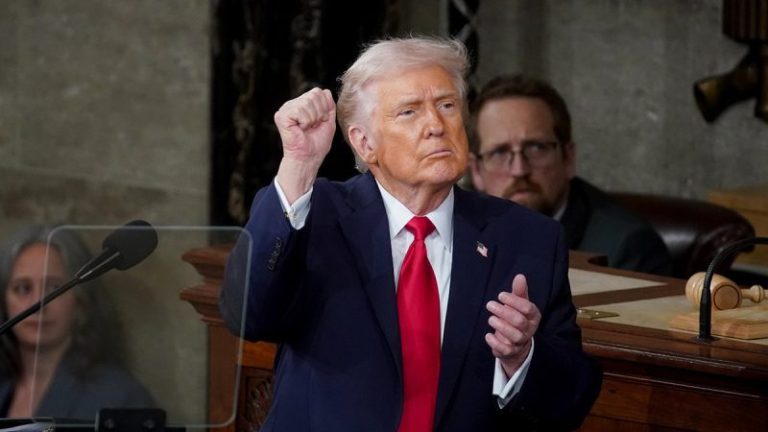
Many conservatives quickly took to social media to praise President Trump’s State of the Union speech, which lasted just under two hours, energizing Republicans and riling Democrats.
‘It’s not just an excellent speech, it’s mostly POTUS himself,’ conservative radio host Mark Levin posted on X. ‘ He’s a truly historic leader. I know it drives DC nuts. Who cares.’
‘Trump is a colossus; an amazingly patriotic speech,’ FOX Business Senior Correspondent Charles Gasparino posted on X.
‘This is the best State of the Union Address I’ve ever seen,’ conservative commentator Buck Sexton posted on X. ‘Not just by Trump. By any President.’
‘President Trump’s State of the Union put America’s greatness on full display—celebrating our war heroes, everyday heroes, and Olympic champions,’ former GOP House Speaker Kevin McCarthy posted on X.
‘The President delivered a home run State of the Union tonight,’ GOP Rep. Chip Roy posted on X.
Democrats on social media struck a different tone, with many prominent faces of the party bashing the president as the speech developed, including California Gov. Gavin Newsom who accused Trump of ‘destroying the country’ and posted ‘that was boring.’
‘That State of the Union speech by Trump was humiliating for both him and the Republican Party,’ liberal influencer Harry Sisson posted on X. ‘He rambled incoherently and Republicans clapped like seals the whole time no matter what was said. I’m glad military heroes were honored, but he lied the entire time.’
Trump’s speech, which was the longest State of the Union in history, focused on what he called a ‘turnaround for the ages’ in the United States during his second term.
Trump invited a swath of various guests to the speech, including everyday Americans, Turning Point USA co-founder Charlie Kirk’s widow, Erika Kirk, the U.S. men’s hockey team fresh off their gold medal win, military members who acted heroically in the time of crisis and families who have suffered tragedy at the hands of illegal immigrants.
Trump’s speech came as the GOP prepares to defend its majority in the House and Senate as the November midterms loom, and also as the nation prepares to celebrate its 250 years of independence.
‘This July 4th, we will mark two and a half centuries of liberty and triumph, progress and freedom in the most incredible and exceptional nation ever to exist on the face of the earth. And you’ve seen nothing yet,’ Trump said. ‘We’re going to do better and better and better. This is the golden age of America.’
Fox News Digital’s Emma Colton contributed to this report

President Donald Trump used part of his State of the Union address on Tuesday to spotlight American military heroism, awarding U.S. Army Chief Warrant Officer Eric Slover and U.S. Navy Captain E. Royce Williams with the nation’s highest military honor.
Recounting what he described as a high-risk January raid targeting Venezuelan leader Nicolás Maduro, Trump detailed Slover’s role in leading the mission. He said Slover was piloting a Chinook helicopter transporting U.S. forces into heavily fortified enemy territory under the cover of darkness. As the aircraft approached the target, it came under intense machine gun fire from multiple directions.
‘There were many heroes on that January raid to capture Maduro. Really great heroes. It was very dangerous,’ Trump said, describing the perilous mission.
‘He absorbed four agonizing shots, shredding his leg into numerous pieces,’ the president continued, telling lawmakers that ‘the success of the entire mission and the lives of his fellow warriors hinge on Eric’s ability’ to keep flying as blood ‘pour[ed] down the aisle.’
Slover, still recovering from his wounds, attended the address with his wife, Amy, as he was presented with the nation’s highest military award.
Trump also presented the Medal of Honor to Williams, a 100-year-old Korean War veteran and retired Navy captain, for his extraordinary combat valor during a long-classified 1952 aerial dogfight over the Sea of Japan.
Flying a single F9F Panther jet from the USS Oriskany, Williams engaged and shot down four Soviet MiG-15 fighters during a 35-minute battle despite being heavily outnumbered and flying an aircraft considered inferior in speed and climb rate.
At the time, the U.S. government kept the encounter secret to avoid escalating tensions with the Soviet Union, which was not officially acknowledged as a combatant in the war. Decades later, after the details were declassified, Williams’ actions were formally recognized with the nation’s highest military honor.
The back-to-back Medal of Honor ceremonies underscored the administration’s emphasis on military service, drawing extended applause from lawmakers and guests in the chamber.
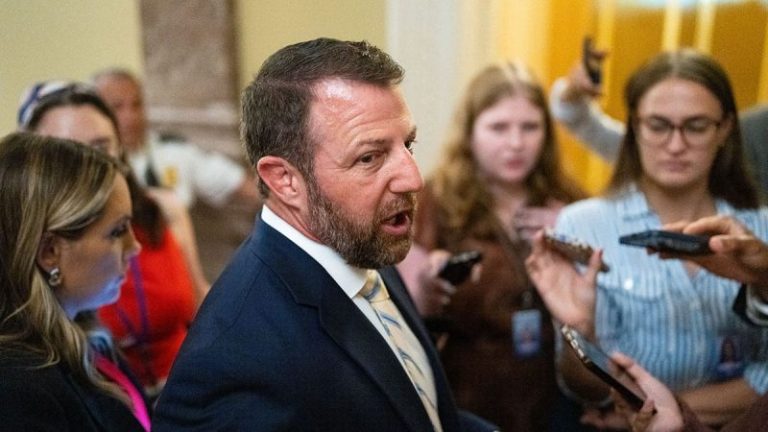
Sen. Markwayne Mullin, R-Okla., on Tuesday urged spring breakers with plans to visit Mexico to cancel their trips due to violent clashes in the country triggered by the Mexican army’s killing of cartel leader Nemesio Rubén Oseguera Cervantes, known as ‘El Mencho,’ earlier this week.
Mullin made the comments during an appearance on CNBC’s ‘Squawk Box,’ in which he said his chiropractor was still planning to visit a popular tourist destination in Mexico.
‘Anybody that’s planning on going to Mexico for spring break … I mean, my chiropractor called me yesterday and said he’s still planning on going to Cancún, I said, ‘Are you crazy?” Mullin said.
‘No one should be going down there right now, it is very volatile and the United States is laser-focused on watching what’s taking place,’ he continued.
The senator’s comments come after Mexican troops conducted operations on Sunday in Tapalpa, Jalisco, targeting El Mencho, a former police officer who became the leader of the Cartel de Jalisco Nueva Generación, which U.S. authorities have identified as a major supplier of fentanyl to the United States.
El Mencho carried a $15 million U.S. bounty and rose to power following the arrest of Joaquín ‘El Chapo’ Guzmán, the former head of the Sinaloa Cartel. Over roughly the past 15 years, the Cartel de Jalisco Nueva Generación has expanded from a regional criminal group into a global trafficking organization operating from its stronghold in Jalisco.
The Mexican Defense Department said the operation was conducted as part of bilateral coordination and cooperation with the U.S., and that U.S. authorities provided complementary intelligence that contributed to El Mencho’s killing.
After El Mencho’s death, cartel members burned cars and blocked roads in several Mexican states. Violent clashes were also reported in parts of western Mexico.
Mexican authorities later said that the security situation had been ‘stabilized.’
‘The security situation has now stabilized following targeted operations in Jalisco,’ the Mexican Embassy in the U.S. said on Tuesday.
‘Federal and State authorities are proceeding to reopen transit corridors and restore public services smoothly,’ the embassy continued. ‘Airline operations are normal, and international carriers are resuming flights today. Puerto Vallarta International Airport has reopened to domestic traffic.’
The embassy added: ‘If traveling through Jalisco, some local security measures remain in place, while authorities are restoring airport operations to full capacity. We are working with international partners to ensure safety and stability at all transit hubs and tourist destinations.’
But the U.S. State Department’s travel advisory for Mexico remains in effect. The U.S. government earlier issued a shelter-in-place order for Americans in Mexico, but that order has since been lifted.
The Cartel de Jalisco Nueva Generación is considered the most powerful cartel in Mexico with an estimated 19,000 members and operations across 21 of the country’s 32 states.
The Trump administration designated the cartel as a foreign terrorist organization.
Mullin said on Tuesday that cartels splitting after Mexico’s operation is a ‘great opportunity for us, and Mexico, to take them all out.’
‘Now, are we going to eliminate all the drug trafficking in the world? Absolutely not. But can we get a handle on it again? Absolutely,’ he added.
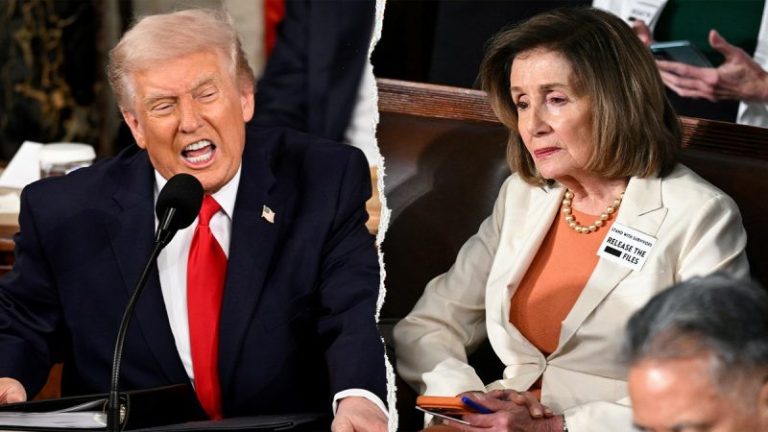
President Donald Trump called out insider trading on Capitol Hill during his address, urging Congress to ‘pass the Stop Insider Trading Act without delay’ while also taking a shot at Speaker Emerita Nancy Pelosi.
‘Let’s also ensure that members of Congress cannot corruptly profit from using insider information,’ Trump said, prompting members of both parties to stand.
Trump responded, ‘They stood up for that. I can’t believe it. I can’t believe it. Did Nancy Pelosi stand up — if she’s here? Doubt it.’
The Pelosi family’s financial disclosures have frequently been cited by critics calling for stricter limits on congressional stock trading.
The Stop Insider Trading Act, introduced by Rep. Bryan Steil, would ban members of Congress, their spouses and dependent children from purchasing publicly traded stocks and require advance public notice before any sale, aiming to go beyond the 2012 STOCK Act’s reporting requirements.
A source familiar told Fox News Digital that Pelosi was applauding until Trump called her out.
The moment captured attention on social media, including from Fox News contributor Guy Benson, who posted on X, ‘lol the Pelosi ad lib.’
‘LMAO at Trump’s callout of Pelosi on insider trading,’ columnist Josh Hammer posted on X.
‘LOL Trump is the funniest President of all time, zero debate,’ Newsbusters Managing Editor Curtis Houck posted on X.
Trump also announced a new retirement savings proposal for workers without access to employer matching, promising the federal government would match contributions up to $1,000 a year so more Americans can benefit from market gains.
Fox News Digital reached out to Pelosi’s office for comment.
Fox News Digital’s Morgan Phillips contributed to this report

The era of “smooth globalization” is over, and mining is entering a more fragmented, politically charged phase defined by strategic nationalism, according to speakers at S&P Global’s latest webinar.
Jason Holden, who opened the “State of the Market: Mining Q4 2025” session with a macro overview, said the industry is operating in a world increasingly shaped by supply chain security and state intervention.
“For decades we operated under a model of frictionless trade,” said Holden, a senior mining analyst at the firm. “That era is over. We’ve entered a world of strategic re-nationalization.”
While the base economic outlook remains resilient, with moderate growth and easing headline inflation, Holden warned that “sticky core inflation remains stubbornly high.”
For mining companies, that has two major implications: higher capital costs and less room for the easy-money valuation surges seen in past cycles. Central banks, led by the US Federal Reserve, are no longer aggressively tightening, but are also not on a clear-cut path to interest rate cuts.
“We’re no longer on a predictable path of easing,” Holden explained to listeners. “The market is now focused on if and when cuts might resume.” At the same time, geopolitical disputes are increasingly spilling into trade policy. The conversation around critical minerals, he noted, has shifted decisively.
“It’s no longer just about economics,’ said Holden. “It’s explicitly framed as national security.”
That shift is driving greater government intervention, subsidies, capital screening and “friend-shoring,” where materials are sourced from politically aligned nations.
Nowhere has geopolitical risk been more visible than in gold.
The metal surged to fresh highs in early 2026 after setting 40 new records in 2024 and 53 more in 2025, a pace not seen since 1979. The price briefly pushed beyond US$5,500 per ounce at the start of the year.
“The message from this price action is unmistakable,” Holden said. “In an uncertain world, the market is paying a premium for insurance, and gold is the ultimate safe asset.”
While short-term flashpoints helped fuel the rally, the structural driver has been central bank buying. Since sanctions in 2022 prompted reserve managers to rethink US dollar exposure, official sector purchases have accelerated.
“The sustained buying from central banks is the real engine behind the rally,” Holden said.
S&P’s base case sees gold averaging US$4,247 per ounce in 2026, with upside potential toward US$6,000 by 2027 in a more bullish scenario.
Luiz Amaral from S&P’s exploration team said copper ended 2025 on strong footing, with London Metal Exchange (LME) prices reaching US$12,500 per metric ton in December.
Supply-side tightness, a weaker US dollar and copper’s growing role in electrification supported prices. The US decision to formally list copper as a critical mineral reinforced its strategic importance.
S&P has lifted its 2026 copper price forecast to US$11,400 per metric ton, projecting a 543,000 metric ton concentrate deficit next year. However, the refined market is expected to move into surplus later in the decade as new smelter capacity ramps up. Longer term, the concentrate picture darkens again.
“Our base case shows a 3 million metric ton shortfall by 2036,” Amaral said.
Nickel’s recent rally, by contrast, has been driven more by policy than fundamentals. The price broke above US$18,000 per metric ton in January after Indonesia reduced its 2026 production quota.
“The market is responding emotionally to policy updates,” Amaral said, noting that despite the rally, the broader market remains in surplus and LME inventories are building.
Lithium prices have also staged a sharp rebound, rising 57 percent in China between mid-December and mid-January on renewed demand optimism and supply concerns. Yet S&P expects the market to remain oversupplied for most of the decade, with deficits not emerging until the early 2030s.
New supply from Australia, Latin America and China continues to outpace demand growth, even as electric vehicles account for roughly 75 percent of lithium consumption through 2035.
At the mine level, gold producers are enjoying some of the strongest margins in years, with prices rising faster than all-in sustaining costs. Silver has outperformed even more dramatically, climbing 154 percent in 2025 versus gold’s 71 percent gain, compressing the gold-silver ratio to below 70.
Battery metals face a tougher backdrop.
“Lithium and nickel continue to face margin pressure as prices lag elevated costs amid oversupply,” said Monica Ramirez from S&P’s mine economics and emissions team.
Across 12 metals analyzed, S&P sees a structurally higher cost environment emerging due to inflation, energy expenses and maturing ore bodies. Precious metals retain the strongest buffers, while copper remains positive but increasingly sensitive at the upper end of the cost curve.
Despite record prices in some commodities, exploration spending tells a more cautious story.
Global exploration budgets totaled US$12.4 billion in 2025, down 1 percent year-on-year. Adjusted for inflation, spending has slipped back to levels last seen nearly two decades ago.
“Gold continues to dominate,” Amaral said, accounting for roughly half of global exploration budgets. Lithium, once a standout, saw budgets fall nearly 50 percent amid weaker prices.
More concerning is the structural shift away from grassroots exploration.
In the mid-1990s, two-thirds of spending targeted generative programs. Today, that share has fallen to a record low as companies prioritize near-mine and late-stage work.
“We are underinvesting at the very front end of the supply chain,” Amaral warned. Without renewed grassroots spending, the long-term discovery pipeline could suffer.
Mining M&A remained active into late 2025, though deal value normalized after earlier mega-mergers. Transaction value fell 45 percent quarter-on-quarter to US$16.1 billion, but deal count rose to its highest level in more than five years.
Gold led activity, with buyers focusing on large-scale, long-life assets in low-risk jurisdictions.
“Gold M&A today is no longer about simple volume growth,” Ramirez emphasized to viewers. “It’s about asset quality, jurisdictional safety and durable cashflow.”
As the webinar made clear, mining is navigating a landscape defined by geopolitical risk, tighter capital and structural cost pressures. For companies able to secure high-quality assets and control costs, opportunities remain, but the margin for error is narrowing.
Securities Disclosure: I, Georgia Williams, hold no direct investment interest in any company mentioned in this article.
Here’s a quick recap of the crypto landscape for Monday (February 23) as of 9:00 p.m. UTC.
Get the latest insights on Bitcoin, Ether and altcoins, along with a round-up of key cryptocurrency market news.
Bitcoin (BTC) was priced at US$64,409.84, down by 4.4 percent over the last 24 hours.
Bitcoin price performance, February 23, 2026.
Chart via TradingView.
XS.com senior market analyst Linh Tran suggested that the medium-term uptrend is limited without major catalysts. She predicts that Bitcoin will fluctuate between US$65,000 support and US$70,000 resistance; however, if current pressures persist, there is a risk of Bitcoin retesting the US$60,000 low, which could trigger a deeper decline.
Software stocks slipped alongside a further decline in crypto prices after Anthropic said its Claude platform can help ‘break the cost barrier to COBOL modernization,’ a high-level, compiled computer programming language that the firm says ‘runs in production every day, powering critical systems in finance, airlines, and government.’
Ether (ETH) was priced at US$1,860.34, down by 4.1 percent over the last 24 hours.
Some parts of the DeFi ecosystem have benefited from the chaos of Bitcoin’s sudden price drop in January, which liquidated billions of dollars’ worth of positions. A DeFi project called Yield Basis, which helps people trade Bitcoin and Ether through its liquidity pools, says it’s handled US$769 million in trades since the beginning of 2026, with more than half occurring after January 28, when crypto prices began swinging wildly.
According to a recent report, the protocol has collected US$12.15 million in fees since it launched its v2 pools in November 2025, compared to US$5.31 million worth of tokens it paid out as rewards, leaving about US$6.84 million in net profit for the users providing liquidity and holding the project’s tokens.
An open-source AI agent framework known as OpenClaw has inadvertently become the center of a crypto controversy. The project, built to power autonomous agents capable of browsing the web and executing complex tasks, was briefly rebranded amid a naming dispute before scammers launched a fake Solana-based token using its former branding.
The token’s market capitalization surged to roughly US$16 million within hours before collapsing more than 90 percent after developer Peter Steinberger disavowed any connection.
Steinberger publicly rejected the speculation, writing on X: “To all crypto folks: please stop pinging me, stop harassing me. I will never do a coin. Any project that lists me as coin owner is a SCAM.”
Tether’s USDT stablecoin is signaling liquidity strain reminiscent of the market turmoil following the FTX collapse.
According to CryptoQuant, the 60 day change in USDT supply has dropped to negative US$3 billion, which marks only the second time such a contraction has occurred. Bloomberg reported that USDT is on pace for its steepest monthly supply decline since December 2022, already shrinking by roughly US$1.5 billion in February alone.
Large-scale redemptions typically suggest institutions or major holders are pulling capital out of the crypto ecosystem rather than simply rotating between tokens. The last comparable contraction came as Bitcoin fell toward US$16,000 during the FTX crisis before stabilizing and beginning a multi-year recovery.
Securities Disclosure: I, Meagen Seatter, hold no direct investment interest in any company mentioned in this article.
Securities Disclosure: I, Giann Liguid, hold no direct investment interest in any company mentioned in this article.
Red Mountain Mining Limited (ASX: RMX, US CODE: RMXFF, or “Company”), a Critical Minerals exploration and development company with an established portfolio in Tier-1 Mining Districts in the United States and Australia, is pleased to announce an update on the Company’s portfolio of high-quality Antimony projects in the United States.
Over the past six months, Red Mountain has moved decisively to acquire assets in Tier-1 regions in highly prospective antimony mineral districts in Montana, Utah and Idaho, USA, placing the Company in a strong strategic position as the US Government moves aggressively to secure domestic supply of Antimony which is classified as a Critical Metal by the United States and Australian Governments.
HIGHLIGHTS:
Thompson Falls Antimony Project, High-grade Antimony next to UAMY Antimony Smelter
Utah Antimony Project, Antimony Mining District
Exceptionally Strong Antimony results from Thompson Falls and further assays pending
Red Mountain acquired the Thompson Falls Antimony Project on 5 February1, next to the only operating antimony smelter in the USA, US Antimony Corporation’s (NYSE: UAMY; Market Cap ~AU$1.5 billion) Thompson Falls Smelter and UAMY’s Stibnite Hill Mine in Montana (Figure 1).
First-pass exploration of Red Mountain’s Thompson Falls Antimony Project, by the Company’s US field team, successfully located three historical underground mines and pit within the project area. Initial sampling of material from Eastern Star returned multiple samples with high antimony and gold results, with peak results of 36.5% Sb and 0.65g/t Au1 (Figure 1; Figure 2).
Samples collected from Eastern Star closely resemble the quartz-stibnite veins mined at UAMY’s Stibnite Hill deposit, ~7km east of Red Mountain’s Thompson Falls Project area, although these veins are not recorded as producing gold. Red Mountain’s field team also collected additional rock samples from the project area, with assay results expected this month.
Click here for the full ASX Release

Raptor Resources (RAP:AU) has announced Raptor Completes Further Drilling at Chester Project
Download the PDF here.