Author

admin

Browsing

A video shared on X shows Erika Kirk at the Turning Point USA office surrounded by staff members, proudly showing them the Presidential Medal of Freedom awarded to her late husband, Charlie Kirk.

In the clip posted by Mikey McCoy, Charlie Kirk’s former chief of staff, Erika speaks movingly to the assembled team.

In the clip, she can be heard saying, ‘I wanted you guys all to see the Medal of Freedom and be able to look at it and the back of it.’

‘You guys are all part of the legacy. Thank you,’ she says warmly.

The Presidential Medal of Freedom is the highest civilian award in the U.S. It was awarded posthumously to Charlie Kirk by President Donald Trump on Oct. 14, 2025, a date that would have been Kirk’s 32nd birthday. 

Erika accepted the award on her husband’s behalf at a ceremony in the Rose Garden at the White House. She also delivered remarks highlighting her husband’s beliefs and sacrifice.

Charlie Kirk was assassinated on September 10, 2025, while speaking at a Turning Point USA event at Utah Valley State University in Orem, Utah.

Following her husband’s death, Erika was unanimously appointed CEO and chair of Turning Point USA’s board.

This post appeared first on FOX NEWS

A teenage street musician has been jailed and charged with leading a public gathering in which she led a crowd in singing an anti-Putin rock song in St. Petersburg, a rare act of defiance, according to local reports.

Diana Loginova faces a single administrative charge for organizing an unauthorized public gathering and has been jailed for 13 days, The Moscow Times reported.

After serving her sentence, Loginova will face an additional administrative offense of ‘discrediting’ the Russian military, Reuters reported.

Loginova, who performs under the name Naoko with the band Stoptime, was arrested Tuesday after being filmed earlier leading a crowd in singing the lyrics to exiled rapper Noize MC’s hit song ‘Swan Lake Cooperative.’

Noize MC, the musician who wrote ‘Swan Lake Cooperative,’ is openly critical of the Kremlin and left Russia for Lithuania after the start of the war in Ukraine.

For its part, Moscow has added him to its list of ‘foreign agents,’ which includes hundreds of individuals and entities accused of conducting subversive activities with support from abroad, Reuters reported.

The song doesn’t reference Russian President Vladimir Putin or mention the war in Ukraine. It is a reference to Tchaikovsky’s Swan Lake, which was played on television after the deaths of Soviet leaders and during the 1991 coup attempt against President Mikhail Gorbachev.

In May, a St. Petersburg court banned the song on grounds it ‘may contain signs of justification and excuse for hostile, hateful attitudes towards people, as well as statements promoting violent changes to the foundations of the constitutional order.’

This post appeared first on FOX NEWS

It’s been yet another historic week for gold and silver, with both setting new price records.

The yellow metal broke through US$4,200 per ounce and then continued on past US$4,300. It rose as high as US$4,374.43 on Thursday (October 16), putting its year-to-date gain at about 67 percent.

Meanwhile, silver passed US$54 per ounce and is now up around 84 percent since 2025’s start.

Gold’s underlying price drivers are no secret — factors like central bank buying and waning trust in fiat currencies have been major themes in recent years, and they continue to provide support.

But it’s worth looking at a number of other elements currently in play.

Among them are a resurgence in the US-China trade war, which has ramped up geopolitical tensions, and the ongoing American government shutdown. The closure has stalled the release of key economic data ahead of the Federal Reserve’s next meeting later this month.

There have also been troubles at two regional banks in the US — they say they were the victims of fraud on loans to funds that invest in distressed commercial mortgages. Aside from that, Rich Checkan of Asset Strategies International sees western investors entering the market.

‘We don’t have a tidal wave or a tsunami by any stretch of the imagination, but the western investor is getting back into this,’ he said, noting that for the past few years his company has mostly been selling to high-net-worth individuals and people looking for deals. ‘Now we’re having flat-out sales.’

Checkan also weighed in on where gold is at in the current cycle, saying the indicators he tracks — including the gold-silver ratio, interest rates and the US dollar — don’t point to a top.

‘They can take a breather, there’s no question about that — you almost kind of want them to. But the reality is, there’s no top in sight,’ he said. ‘I’ve got about, I don’t know, seven, eight, nine different indicators I look at for the top in a bull market for gold. None of them are firing.’

When it comes to silver, the situation is a little more complicated.

Vince Lanci of Echobay Partners explained that the London silver market is facing a liquidity crisis — while there’s not a shortage of the metal, it isn’t in the right place, and that’s creating a squeeze.

Here’s what he said:

‘London, when it needs metal, is having a hard time getting it from Asia, because China is not cooperating with the west — for good reason in their mind. And for some reason, the US is not making its metal available as robustly as it used to, to help fill refill London’s coffers. And so that creates a short squeeze.

‘There’s enough metal in the world for current needs — let’s say for today’s needs. But it’s not where it should be. So it’s a dislocation.’

Lanci, who is also a professor at the University of Connecticut and publisher of the GoldFix newsletter on Substack, also made the point that although these circumstances are front and center now, they’re just one part of the larger ongoing bull market for silver. In his view, its growing status as a critical mineral will have major implications, and a triple-digit price is realistic.

Arcadia Economics interview

As a final point, I was recently interviewed by Chris Marcus of Arcadia Economics.

It was fun being on the other side of the camera for a change, and I have a new appreciation for everyone who sits down to answer my questions. Check out the interview below.

Securities Disclosure: I, Charlotte McLeod, hold no direct investment interest in any company mentioned in this article.

This post appeared first on investingnews.com

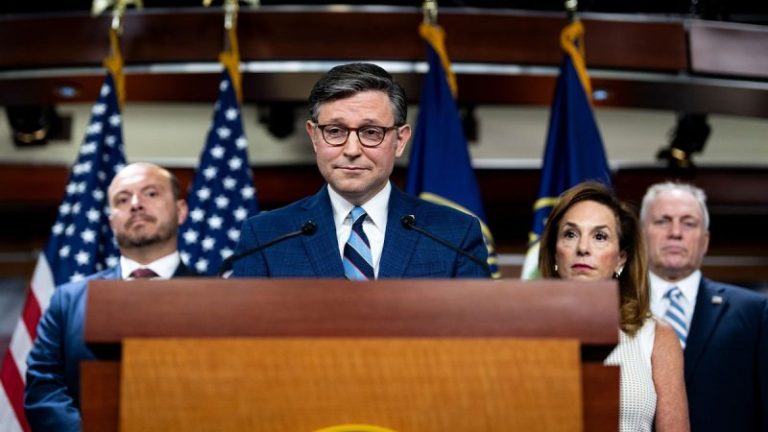
House Republicans in battleground districts appear to be closing ranks as GOP leaders dig in on their government shutdown strategy, while the fiscal standoff shows no signs of slowing. 

Eight House GOP lawmakers whose seats are being targeted by Democrats in 2026 spoke with Fox News Digital this week. And while some shared individual concerns, they were largely united in agreeing with Speaker Mike Johnson, R-La., that Republicans should not renegotiate their federal funding proposal — and were confident that Americans are behind them.

‘The more people understand the math inside of the Senate, the more I would say Republicans are winning,’ said Rep. Rob Bresnahan, R-Pa., who defeated a moderate Democrat for his seat last year.

Rep. Jen Kiggans, R-Va., who also flipped her seat from blue to red, argued the results of the 2024 election show Americans ‘can see through a lot of the games that the Democrats have been playing.’

‘We’ve gotten to work with the demands of the American voters, and Democrats are still in disarray,’ she said.

Rep. Derrick Van Orden, R-Wis., said, ‘It’s a simple math problem. And the Democrat Party grossly underestimated the American public’s ability to understand math.’

For a House GOP conference that’s been plagued by historic levels of division in recent history — particularly over the issue of government funding — it has shown a notable display of unity amid the shutdown, with few exceptions.

The shutdown is poised to roll into next week after most Senate Democrats voted to block the GOP’s bill for a tenth time. 

Republicans put forward last month a seven-week extension of fiscal year (FY) 2025 funding levels, called a continuing resolution (CR), aimed at giving congressional negotiators more time to strike a long-term deal for FY2026.

But Democrats in the House and Senate were infuriated by being sidelined in those talks. The majority of Democrats are refusing to accept any deal that does not include serious healthcare concessions, at least extending COVID-19 pandemic-era Obamacare subsidies that are set to expire at the end of this year.

Several vulnerable Republicans who spoke with Fox News Digital pointed out they’re in favor of extending the Obamacare subsidies as well. Indeed, a majority of them are backers of a bipartisan bill to extend them for one year, led by Kiggans.

‘I think we would actually prefer to have … longer term than one year,’ said Rep. Ryan Mackenzie, R-Pa.

But Mackenzie also pointed out that House Minority Leader Hakeem Jeffries, D-N.Y., criticized the one-year bill, adding, ‘He already said ‘Absolutely not,’ so I don’t even know what their position is and what they’re asking for.’

Jeffries walked those comments back somewhat a day later, telling reporters that Democrats were willing to look at any good-faith offer.

Kiggans told Fox News Digital, ‘I care about that issue, certainly, you know, I had introduced that [Affordable Care Act] premium tax cuts extension.’

She added that Obamacare, formally called the ACA, and reopening the government are ‘two different issues, though’ that should be discussed separately.

The House Republicans who spoke with Fox News Digital, while largely supportive of discussing Obamacare subsidy reforms and extensions, were united in refusing to entertain Democrats’ demands to come back to the negotiating table on federal funding. All maintained, in some form, that the House did its job in passing the CR on Sept. 19.

‘We have a clean CR that would fund all of the programs — all of the federal employees, keep everything up and running through Nov. 21st, so that we can finalize FY2026 appropriations and address issues like healthcare. But you don’t do it at the barrel of a gun,’ said Rep. Mike Lawler, R-N.Y.

Lawler is one of three House Republicans who won in a district that President Donald Trump lost in 2024.

‘I think what the Democrats are doing here is creating a mess for the American people. And they’re not actually solving any of the problems,’ he said.

Mackenzie said, ‘It was a seven-week continuing resolution so that we could have time to have policy discussions on other issues that did need to be wrapped up by the end of the year. And we were on track to do that. And I think [Democrats] totally blew that process up.’

‘This is an unprecedented thing that Senate Democrats are doing, trying to add policy programs into the new continuity of funding bill,’ Rep. Tom Kean, R-N.J., the most vulnerable Republican in the Garden State, also said.

Both Lawler and Rep. Dave Valadao, R-Calif., warned that giving up a policy rider-free spending bill in favor of inserting partisan demands would create an unworkable new standard.

‘Holding the government office is never a good strategy. And if it becomes a successful way of negotiating … it’ll set a bad precedent for governing moving forward,’ Valadao said. ‘So this is an absolute no-go, should never be successful.’

Lawler said, ‘The reality is, the moment you start giving in on a clean CR and start giving in to demands, this will continue in perpetuity. Every time there’s a government funding lapse, you’ll have a group of people demanding something, and it will turn into a fiasco.’

Several of the battleground Republicans also praised Johnson and Senate Majority Leader John Thune, R-S.D., in the process.

Valadao told Fox News Digital, ‘I think they’re doing a good job. At least all the calls I’ve been on, the conversations I’ve had with my colleagues and, again, folks in the district, they all seem pretty confident that we’re doing the right thing.’

Lawler said Johnson had ‘handled it well,’ while Bresnahan said, ‘I would say, at least with members, they’re, you know, keeping very fluid conversations. We have daily or at least biweekly calls here as to what the messaging needs to be and what the conversations are.’

But there has been some dissent within the House GOP as the shutdown drags on.

Rep. Marjorie Taylor Greene, R-Ga., has criticized House Republican leaders for not announcing a plan on extending the Obamacare subsidies.

And Rep. Kevin Kiley, R-Calif., publicly ripped Johnson’s decision to keep the House out of session while the Senate considers the CR.

‘It is absolutely unacceptable to me and I think only serves further distrust,’ Kiley told MSNBC on Wednesday.

Notably, not all battleground House Republicans who spoke with Fox News Digital directly backed Johnson’s move — but none explicitly condemned it, either, and most blamed Senate Democrats for the holdup.

‘I’m kind of torn on that, because to come back and just be a part of the gimmicks that you see going on right now is not helpful,’ Valadao said. ‘Holding the government hostage is what’s the problem here.’

Kiggans, who said she’s lobbying for the House to vote on a standalone bill to pay both active duty and civilian members of the military, said, ‘I think we all want to get back to work. We know that we have work to do, but the ball’s in the court of the Senate Democrats and Chuck Schumer.’

Others more directly backed the move, however.

Kean told Fox News Digital that his staff were still busy in D.C. and in New Jersey trying to help constituents navigate the shutdown and other matters.

‘Any chance we can get back to our district, it’s always important that we listen to our constituents and hear their concerns,’ Kean said. ‘Right now, I 100% support the decision.’

Rep. Zach Nunn, R-Iowa, said it was ‘the right move.’

‘We should be with our district. I’m keeping all my district offices open despite nobody getting paid,’ Nunn said. ‘Coming back and having a theatrical debate is less effective than having a real conversation about how to get the government back open.’

This post appeared first on FOX NEWS

In theory, this should be a moment of vindication for the Free Palestine movement. A ceasefire holds. Israel has pulled back troops. International headlines finally reflect what activists have shouted for months: that Gaza’s suffering matters. 

And yet, the plazas are still. The hashtags have gone dormant. The chants that once shook campuses have faded into uneasy silence.

Why? 

Many activists can’t celebrate because celebration feels like surrender.

Behavioral science has some explanations. First, there’s cognitive dissonance at play. When the suffering that fueled your cause suddenly ends, any gesture toward happiness feels obscene. They still see bombed hospitals and displaced families. To cheer would feel like betrayal – not of Israel, but of grief itself.

Second, social identity theory tells us people bond most tightly when facing a common enemy. But when the enemy momentarily recedes, cohesion falters. You can see it in activist networks now debating purity tests and political hierarchies: who’s really anti-colonial, who’s performative. The silence isn’t apathy; it’s fragmentation.

And then there’s the matter of trust. The Free Palestine movement’s emotional currency is their perceived moral authenticity. That’s why President Donald Trump, despite questioning aid to Israel, gains no credit here. Even if he were to deliver every demand the Free Palestine movement has ever made – an end to occupation, full recognition, humanitarian aid – he would get no credit. 

To them, he is not a messenger; he is a metaphor. His name evokes everything they stand against: nationalism, hierarchy, cruelty disguised as strength. Their ears are hardened not by indifference, but by identity. When a message comes from a symbol of what you despise, its meaning dies on arrival. That’s not hypocrisy – it’s human nature. We hear only what affirms who we are. What remains is a vacuum of feeling – neither victory nor defeat, just unresolved tension.

For many, that tension is unbearable, so silence becomes self-protection. But silence has a cost.

A movement that cannot speak when conditions improve loses moral clarity. If the world only hears you when you’re angry, it stops listening when you’re right. The tragedy of the Free Palestine silence is not hypocrisy; it’s heartbreak. It reveals how thoroughly moral identity has replaced moral imagination.

To move forward, supporters must learn to celebrate small mercies without mistaking them for betrayal – to see progress not as perfection, but as proof that pain is finally being heard. Until then, the quiet will continue. Not because there’s nothing to say, but because joy, after so much rage, feels foreign on the tongue.

This post appeared first on FOX NEWS

The gold price continued to rise in Q3, breaking through key milestones to set new all-time highs.

Much like the first half of the year, the yellow metal was supported by ongoing factors like central bank buying, geopolitical tensions and uncertainty caused by US trade and tariff policies.

And it wasn’t just the price of gold that soared — higher margins and a more positive outlook for the sector helped drive increases in gold stocks. Read on for a look at gold’s Q3 activity and the outlook for Q4.

What happened to the gold price in Q3?

Gold has gained nearly US$1,400 since starting the year at US$2,658 per ounce on January 2.

By the beginning of Q3, gold had climbed to US$3,338.86, and it remained rangebound at that level for most of July and August. However, it climbed above the US$3,400 mark on July 22 and then again on August 6.

Gold price, July 9 to October 10, 2025.

The price started to gain traction at the end of August, after US Federal Reserve Chair Jerome Powell signaled a change in policy during his remarks at the Jackson Hole Economic Policy Symposium. By September 2, the gold price had broken through US$3,500 for the first time, and by September 8 it had climbed above US$3,600.

As the month wore on, gold continued its unprecedented climb. It broke through US$3,700 on September 22, US$3,800 on September 29 and reached its quarterly high of US$3,858.41 on September 30.

The price continued on its upward trajectory as the fourth quarter began, rising above US$3,900 on October 6, and finally setting a new record high of US$4,040.42 on October 8.

What’s driving gold demand?

Although there was a dip in central bank gold purchases in July, with just 10 metric tons added to reserves, the World Gold Council (WGC) reported that the buying trend that has developed over the past few years remains firm.

In August, central banks once again increased their gold acquisitions, purchasing a total of 19 metric tons. Overall, central banks bought 415 metric tons of gold in H1, bringing the 2025 total to 444 metric tons as of the end of August.

Although it appeared to pause its gold buying in August, the National Bank of Poland has been the top purchaser of gold in 2025, adding 67 metric tons. It has vowed to have 20 to 30 percent of its international reserves in gold.

The WGC notes that seven central banks boosted their reserves in August. Kazakhstan was the leading buyer, adding 8 metric tons to its holdings and bringing its year-to-date increase to 32 metric tons. Turkey, Bulgaria, China, Uzbekistan, Ghana, Indonesia and the Czech Republic each added 2 metric tons. Russia was the only seller in August, divesting itself of 3 metric tons of gold; the WGC suggests its reduction was owed to its coin-minting program.

It wasn’t just central banks buying gold. Western investors helped drive record exchange-traded fund (ETF) inflows of US$26 billion for the third quarter, with North American markets accounting for US$16.1 billion.

Total assets under management surged to US$472 billion, a 23 percent increase over the second quarter, with holdings rising to 3,838 metric tons, just shy of the 3,929 metric tons recorded in November 2020.

Why are investors interested in gold?

Mind Money CEO Julia Khandoshko suggested that geopolitics is a driving force behind gold’s record-breaking run, noting that tensions are high as the world becomes increasingly divided into “risk” and “stability” zones.

While geopolitics may be a primary factor, it’s far from the only one.

The third quarter saw declining yield curves, a weakening US dollar and a 25 basis point interest rate cut from the Fed in September, all of which added tailwinds to the gold price. Looking forward, the expectation is that the Fed will make further rate cuts before the end of the year, which could further fuel a rising gold price.

‘The history of the last hundred years shows that gold grows confidently at low rates. Combine this with stubborn inflation, and we can say with confidence that it will create more space for gold’s price rise,” Khandoshko stated.

Additionally, there is an expectation that a weaker US dollar will help to keep the price of gold elevated. So far this year, the US Dollar Index has declined 8 percent.

“The US dollar is a critical component to what happens to gold, because gold is denominated in US dollars, so the weaker the US dollar, the stronger the commodity price. What we’re expecting to see over the next 12 to 24 months is continued devaluation of the US dollar, which means gold should continue to be stronger going forward,” he said.

Among the recent drags on the dollar is fear of a prolonged shutdown of the US federal government after lawmakers failed to reach an agreement to continue funding government agencies and employees.

In the aftermath of the shutdown, the US Dollar Index posted its worst week since July. In an October 3 Reuters article, Thierry Wizman, monetary strategist with Macquarie, suggests that a prolonged shutdown could have a significant impact on trust in the federal government and further impact the strength of the greenback.

Gold price forecast for 2025

Hodaly sees the factors behind gold’s price rise remaining in place for the foreseeable future.

“We are expecting this could go much higher, at least 10 to 20 percent higher in the near term,’ he said.

‘Nothing has changed with the demand outlook for gold and the projected weakness of the US dollar, and that’s what’s going to drive the commodity price higher,’ added the executive.

Gold equities are also expected to benefit as the rising price boosts their margins and share prices.

Leading producers such as Agnico Eagle Mines (TSX:AEM,NYSE:AEM), Newmont (NYSE:NEM,ASX:NEM) and Barrick Mining (TSX:ABX,NYSE:B) have seen their share prices rise by over 100 percent in 2025.

The junior space has also been impacted, with PPX Mining (TSXV:PPX,OTC Pink:SNNGF) posting a year-to-date gain of 642 percent as of October 1, and San Lorenzo Gold (TSXV:SLG,OTC Pink:SNLGF) increasing 629 percent.

With gold now trading above US$4,000, the sector could attract renewed interest and offer new opportunities for investors. Those seeking to include gold or gold stocks in their portfolios might consider options ranging from the relative safety of ETFs and established producers to riskier assets at the development or exploration stages.

Securities Disclosure: I, Dean Belder, hold no direct investment interest in any company mentioned in this article.

This post appeared first on investingnews.com

President Donald Trump on Wednesday signed a directive ordering the Department of War to keep paying U.S. troops despite the ongoing government shutdown, bypassing Congress after lawmakers failed to reach a funding deal for weeks.

The White House said the move is necessary to protect ‘military readiness’ as the budget standoff stretched into its third week. The order, issued as National Security Presidential Memorandum-8 (NSPM-8), directs the department to use available fiscal year 2026 funds to cover military pay and allowances.

‘The current appropriations lapse presents a serious and unacceptable threat to military readiness and the ability of our Armed Forces to protect and defend our Nation,’ the memo states.

Trump cited his Article II powers as commander-in-chief in issuing the order, which covers active-duty troops and reservists on service orders. The directive instructs officials to use only funds that are legally tied to military pay, in coordination with the Office of Management and Budget (OMB).

More than one million service members were expected to miss paychecks starting this week if Congress didn’t act. Trump’s move marks a break from past administrations, which often waited for bipartisan deals instead of intervening directly.

Rep. Nick LaLota, R-N.Y., told Fox News Digital that ‘Trump’s mid-month action was welcome news to the military community. But now that same community is anxious about what happens at the end of the month, where mortgages and rents and car payments all become due.’

‘Democrats were wrong to try to use troop pay as leverage to accomplish their political goals. And it would be wrong, it would be just as wrong, for a Republican to hope that that lack of pay would be a catalyst to get Democrats to acquiesce,’ LaLota said. ‘[Trump is] protecting the troops when Congress won’t.’

The Pentagon has not said which specific accounts will be used. Reports from Roll Call and Reuters indicate the administration has identified roughly $8 billion in unobligated defense funds as potential options.

Critics warn the move could face legal challenges under the Antideficiency Act, which bars spending money not appropriated by Congress. But White House officials argue the law permits spending that has a ‘reasonable, logical relationship’ to the purpose of the original funds: in this case, keeping troops paid.

The directive follows Trump’s Oct. 11 order to keep troop payments flowing during the shutdown. The White House’s latest move Wednesday with Congress still in gridlock could shape government shutdowns for generations to come.

Fox News Digital’s Elizabeth Elkind contributed to this report.

This post appeared first on FOX NEWS

The State Department told Fox News that it is aware of reports Wednesday that two American tourists were attacked in a popular European seaside destination that local media and police said left one person dead and another wounded.

The alleged attack happened early Wednesday in Cascais, Portugal, a coastal resort town about 20 miles west of Lisbon. 

Video taken by Reuters showed blood stains on a sidewalk, where a stabbing had taken place during an attempted robbery, according to media reports.

A State Department spokesperson told Fox News Digital that the agency takes seriously its commitment to protect U.S. citizens abroad and stands ready to provide consular assistance. 

‘One of the young men died at the scene and the other suffered injuries to his face and arms and was taken to [a] hospital,’ the Portugal Resident newspaper cited the Lisbon Metropolitan Command police force as saying.

The attack was carried out by three suspects who fled the scene in a vehicle, the newspaper added.

Further details about the incident and the identities of the victims were not immediately available. 

This is a developing story. Please check back for updates. 

Fox News’ Nick Kalman contributed to this report.

This post appeared first on FOX NEWS

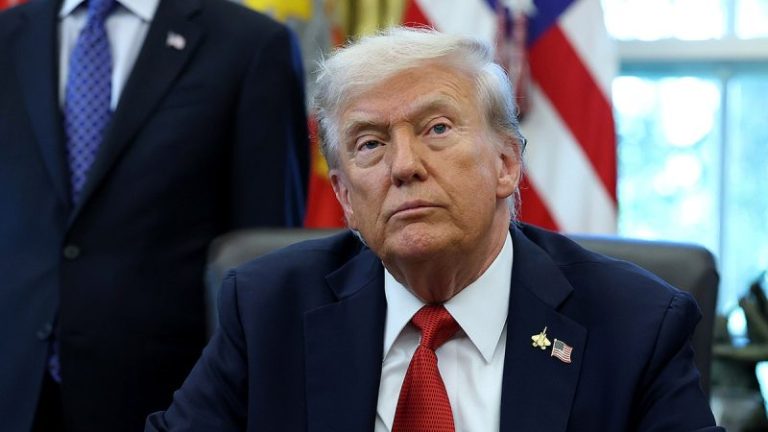
President Donald Trump on Wednesday announced federal law enforcement will next set its eyes on San Francisco, commending the FBI’s more than 23,000 violent criminal arrests, which he said is more than double the number arrested in the final year of the Biden administration.

During an Oval Office news conference at the White House, Trump said the FBI has ‘destroyed or severely disrupted’ more than 170 organized criminal enterprises and gangs, 1,600 of the most violent gangs, and confiscated more than 6,000 illegal firearms since he was sworn in.

He added he wants to make every city safe, and his focus has turned to San Francisco.

‘These are great cities that could be fixed,’ the president said. ‘I’m going to be strongly recommending … [we] start looking at San Francisco. I think we can make San Francisco one of our great cities. … It’s a mess, and we have great support in San Francisco. … Every American deserves to live in a community where they’re not afraid of being mugged, murdered, robbed, raped, assaulted, or shot.’

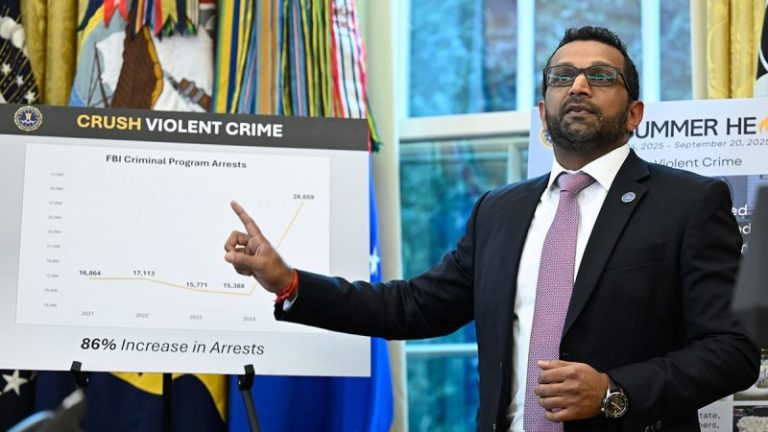
During the news conference, FBI Director Kash Patel announced ‘Operation Summer Heat,’ which the FBI created to target violent criminals, yielded 8,700 arrests of violent offenders in three months.

More than 2,200 guns and 421 kilograms of fentanyl seized during the operation—enough fentanyl to kill 55 million Americans, according to Patel.

To date, he said the FBI has seized 1900 kilograms of fentanyl—enough lethal doses to kill 127 million Americans alone to date.

‘If you look at the past four years of the Biden administration, [there were] 16,000, 17,000, 15,000, 15,000 … arrests year over year of violent felons in this country,’ Patel said. ‘You have 28,600 arrests of violent felons in just seven months alone because of your leadership and the dedication of the men and women at the FBI who want to go out there and do the job they were prevented from doing. … This number is historic by every metric.’

Patel also highlighted the FBI’s efforts to find missing children, claiming 5,400 were located since January.

‘That is a 30% increase year to date over the last administration,’ he said. ‘Violent crimes against children arrests alone are up 10% [and] gang arrests are up 210% in the last seven months alone. … Mr. President, you said we have to go after the worst of the worst. … This is just the beginning.’

This post appeared first on FOX NEWS